
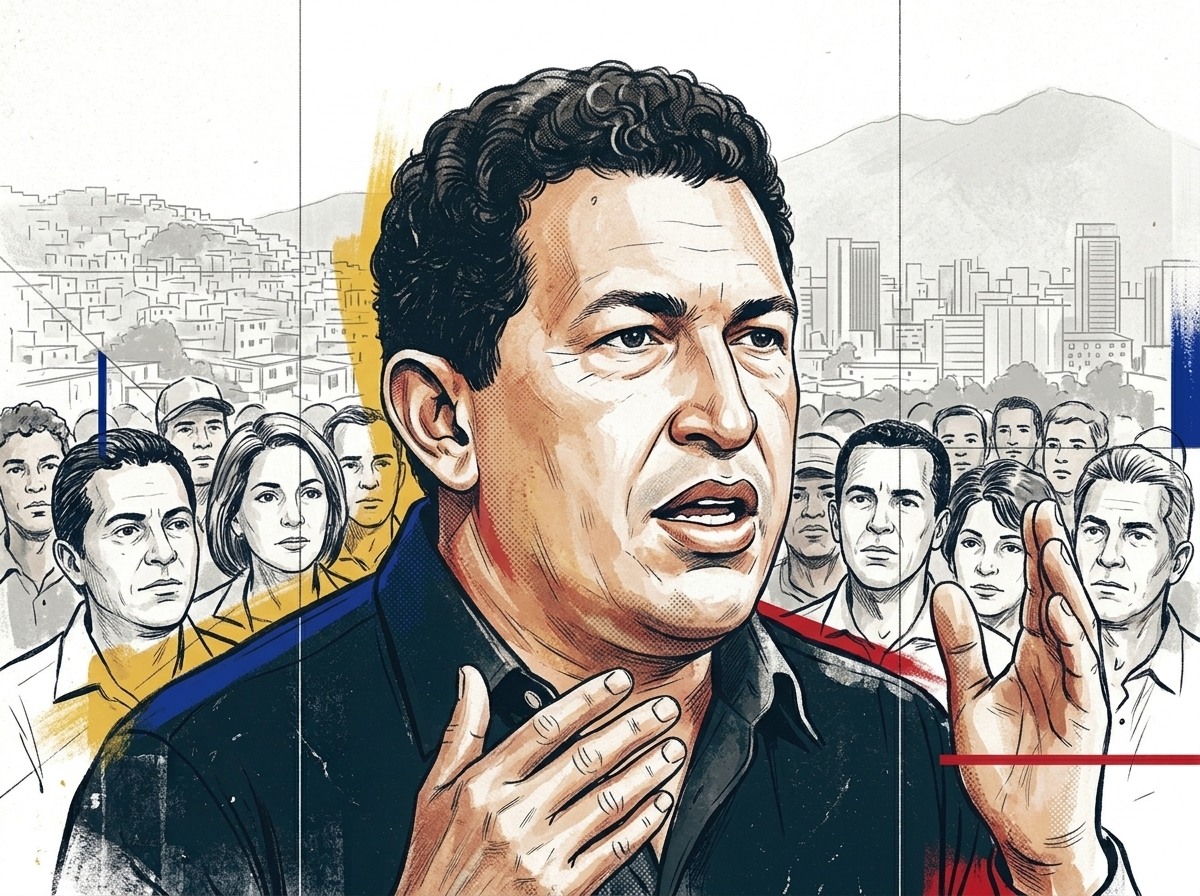
A crisis before the candidate
The arrival of Hugo Chávez is not understood if one begins on the election night of December 1998. The political system born after 1958 had built regular elections and alternation, but also a very centralized relationship between the State, oil revenues and parties. The fall in income, debt, economic adjustments, corruption and the distance between leaders and citizens undermined its legitimacy. Black Friday of 1983, the Caracazo of 1989, the coup attempts of 1992 and the dismissal of Carlos Andrés Pérez in 1993 were different crises; Together they expressed that the political order could no longer respond to the demand for change with its usual mechanisms.
MVGA's criticism relates Chávez's rise to that exhaustion and to the culture of state dependency that preceded him. This reading does not mean that the party system was identical to Chavismo nor that all Venezuelans voted for the same reasons. It means that the traditional opposition failed to regain credibility and that the promises of a radical refoundation found a wide audience.
The 1992 coup and the construction of a national figure
On February 4, 1992, Hugo Chávez led a military rebellion against constitutional president Carlos Andrés Pérez. The attempt failed. After the surrender, Chávez appeared on television and assumed responsibility for his forces; His “for now” turned a military defeat into a political promise of return.
The episode was a coup d'état, not an electoral protest. His causes and supports must be studied, but his failure did not give him a mandate to govern. The political system, however, failed to isolate him as a public figure. For part of the population, Chávez represented punishment for a discredited political class; For others, he was a soldier who had tried to overthrow an elected government by force of arms. That tension accompanied his entire campaign.
In 1994, President Rafael Caldera granted a dismissal of the judicial proceedings against the insurgent military officers. Chávez was released from prison and was able to develop a political career. The measure was a government decision within a context of crisis and negotiation; It does not amount to an absolution regarding the legitimacy of the coup nor does it prove that the political elite had planned Chávez's subsequent rise.
From insurrectional movement to electoral campaign
Chávez and his allies transformed the Bolivarian Revolutionary Movement 200 into the Fifth Republic Movement and built an electoral coalition known as the Patriotic Pole. His message combined rejection of partisanship, a promise to combat corruption, a call for a Constituent Assembly and a new legitimacy founded on the people. The offer touched on real grievances and offered an understandable change from traditional parties associated with governments, pacts and a persistent economic crisis.
Chávez's adversaries faced credibility and coordination problems. Irene Sáez, initially a candidate with high support, lost momentum when she announced her alliance with COPEI; Henrique Salas Römer ended up as the main rival, bringing together sectors that feared the Chavista proposal. Support for Chávez also changed during the campaign: some parties and figures joined his coalition, while others left. It was not simply "the people against the parties"; It was an election with alliances, calculations and preferences that moved until the closing.
What the electorate decided
On December 6, 1998, Chávez obtained 3,673,685 votes, 56.20% of the valid votes. Salas Römer received 2,613,161 votes, 39.97%. The electoral observation mission of the Organization of American States documented the election and reported that 96% of valid votes were concentrated between the two main alliances. The result was a clear victory at the polls.
That mandate must be recognized without turning it into an argument for everything that came after. The voters supported a candidate who promised to change the system and call for a constituent process; They did not vote for every measure that a future government might take, nor did they give up their rights to oppose, organize, and control power.
From the constituent promise to the new Constitution
The constituent call was a central campaign promise. On April 25, 1999, a consultative referendum was held on the call for a National Constituent Assembly. Then its members were elected and, in December, the text of the 1999 Constitution was submitted to a referendum. The Inter-American Commission on Human Rights reconstructs these steps and recognizes their electoral origin.
The same Commission examined the institutional design and the transition regime. In its 2003 report, it expressed concern that the transitional regime extended beyond its temporality and assumed legislative guidelines that, in its opinion, exceeded the transition function. This illustrates a central issue for the Chávez story: a process can begin with votes and, at the same time, generate conflicts over boundaries, separation of powers, and institutional continuity.
The 1999 Constitution expanded rights, reorganized public powers and changed the official name of the country to the Bolivarian Republic of Venezuela. Its popular approval was a fact; It is also true that the new order opened a dispute about the concentration of authority and the role of institutions. The evaluation should not replace chronology with a label: each reform, sentence, election and executive decision must be studied.
What MVGA concludes
Chávez came to power because he obtained an electoral majority in a society that distrusted parties and wanted a refoundation. The crisis was not caused by a single president or a single party, and the 1998 election was not a simple manipulation: it was a real citizen decision within a crisis of legitimacy.
The lesson for MVGA is that rejection of the system can open the door to new personal power if the change proposal does not define limits before governing. Opposition to old politics does not guarantee better institutions. A Sixth Republic will have to resolve this paradox: allow a deep political rupture and, at the same time, protect pluralism, the separation of powers, rights and the possibility of replacing the government by peaceful means.
Sources and references
- Georgetown University, Political Database of the Americas, 1998 presidential results. Compilation that attributes the results to the CNE; It was contrasted with the Carter Center observation report.
- Organization of American States, 1998 electoral observation mission, report.
- Inter-American Commission on Human Rights, Democracy and Human Rights in Venezuela (2009), chapter on political rights.
- Inter-American Commission on Human Rights, Report on the general situation and the constituent process (2003) and chapter on the transitional regime.
- Constitution of 1999, consultation copy of the Political Database of the Americas, Georgetown. Consultation copy; This essay summarizes the process and does not reproduce provisions like an official edition.
- Carter Center, 1998 election observation report, CNE results table.