
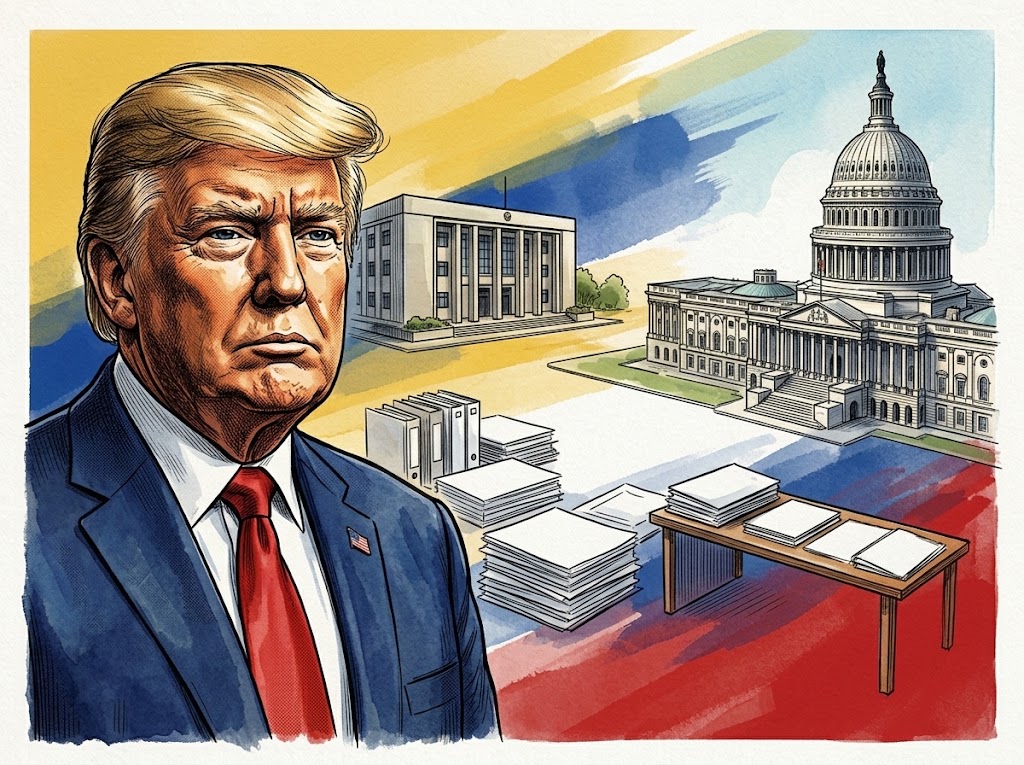
An idea this project wants to discuss
Make Venezuela Great Again expresses a political affinity with Donald Trump that can extend to a provocative aspiration: wanting him as head of state and considering Venezuela as a possible state of the American Union. That preference deserves to be stated clearly. It is a proposal for discussing the future, not a description of an incorporation that has already occurred or of a Venezuelan office Trump currently holds.
The question is uncomfortable because it breaks a habit: assuming that the only legitimate options are those offered by the same leaderships. For MVGA, the discussion begins with the failure of socialism, dependence on resource rents and party domination to build autonomous citizenship. A population that has seen its sovereignty invoked while its opportunities to live freely are destroyed can ask which institutional arrangement would best protect its future. That question should not be shut down with a patriotic insult.
A conversation that also reached Washington
On May 11, 2026, John Roberts discussed his conversation with Trump and the possibility of Venezuela becoming the 51st state on The Guy Benson Show. The Fox News Radio record documents that the idea entered that public conversation. A statement, an image or a presidential preference does not by itself constitute an admission procedure. The proposal’s political interest and its legal status must be examined separately.
MVGA’s affinity with Trump stems from his decision to act against Maduro and from the desire for a break with an exhausted system. The integration proposal adds another question: whether that break should lead to a much closer institutional relationship with the United States. Admiration for one person can open the conversation; the decision would affect generations living under rules that outlast that person.
The case in favour: safeguards independent of the party
Supporters of incorporation may seek a stable federal framework, protection of property, courts able to limit power and economic opportunities less dependent on political favours. They may also value access to a larger market and shared citizenship. These arguments deserve development; they are not automatic results that can be promised by changing a flag. Each benefit depends on the agreement, institutions and implementation.
For MVGA, the central attraction of that possibility would be a break with a leadership’s ability to treat the country as its property. Citizens should be able to work, save, invest and dissent without constantly awaiting political permission. The proposal becomes defensible through the concrete safeguards it might offer, not through the idea that every decision by a foreign government must be accepted without scrutiny.
The objections that must be answered
Incorporation would transform Venezuela’s international sovereignty and raise questions about representation, language, law, taxes, natural resources and the distribution of powers. It would also affect the United States: admitting a new entity changes an existing political community and requires decisions by its institutions. A serious proposal needs participants on both sides and public conditions, not unlimited confidence in a moment of goodwill.
The objection concerning identity deserves a better response than mockery. Political integration does not by itself explain what would happen to a culture, memory or language; those issues require safeguards and decisions. Nor should every objection to the idea be assumed to defend Chavismo. Someone can reject socialism and prefer an independent Venezuelan republic. That disagreement should compete through arguments with the integration alternative.
What the constitutions allow us to say
Article IV, Section 3 of the US Constitution assigns admission of new states to Congress. A president’s preference is insufficient to bring it about. On the Venezuelan side, Article 1 of the Constitution affirms independence and describes sovereignty and other national rights as inalienable. The proposal therefore faces fundamental constitutional obstacles; a favourable poll or a slogan does not resolve them. This essay does not present an already approved legal route for overcoming them.
It is also necessary to distinguish incorporation as a state, territorial status, association, alliance and cooperation. They do not necessarily offer the same representation or rights. Using the phrase 51st state for any US influence confuses different relationships. Before defending an arrangement, it is necessary to specify what is proposed, who could decide it and what safeguards would protect the people subject to it.
An open aspiration, a concrete demand
MVGA can promote the horizon of a 51st state without pretending that an agreement already exists or treating sympathy for Trump as proof of feasibility. The proposal expresses the desire for a deep break with the politics that impoverished the country. To advance as a programme, it would need to demonstrate free consent, equal conditions, protection of rights and a constitutional solution open to scrutiny. The uncertainty of that path does not prohibit discussing it.
The controversy leaves a demand that also applies to those preferring another outcome: explain how they will prevent Venezuela from becoming a leadership’s spoils again. Independence needs free citizens to have substance; integration would need safeguards to deserve support. This library starts from the premise that Venezuelans have the right to consider alternatives without accepting that the same political failure should forever monopolise what is possible.
Sources and references
- Fox News Radio · John Roberts on his conversation with Trump, May 11, 2026
- National Archives · US Constitution, Article IV, Section 3
- Constitution of Venezuela · Article 1 · 1999 text, Georgetown archive