
The Names and the Decision
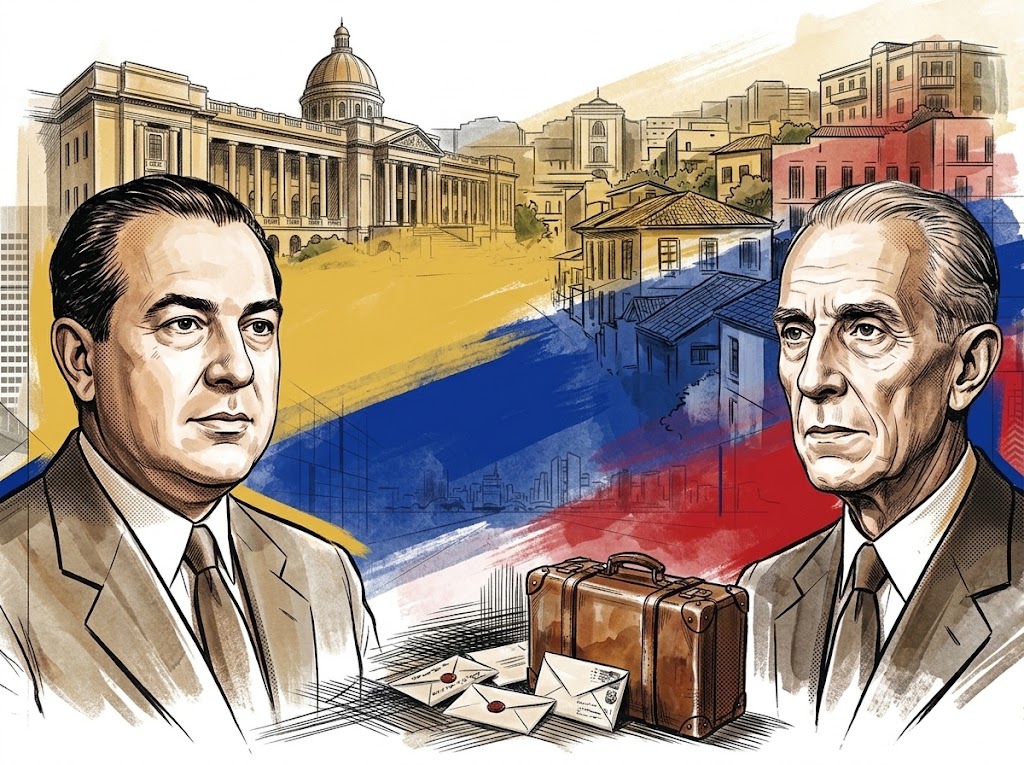
The headline in El Nacional on November 30, 1945, is unequivocal: Medina, López Contreras, and fourteen former officials had been sent into exile. The statement reproduced lists Isaías Medina Angarita, Eleazar López Contreras, and Arturo Uslar Pietri, among others. This is not merely a retrospective account provided by their adversaries; the new government’s announcement formally records the decision to banish them from the territory.
The Junta justified the measure on grounds of security and its responsibility to the nation. It stated that it would not prevent those affected from defending their interests through legal counsel. This explanation reveals the episode's central tension: the government required to demonstrate the existence of a threat was the very same one deciding to remove those capable of challenging its legitimacy and its version of the past.
Security as a rationale for exclusion
The declaration framed banishment as an alternative to detention—a state the expelled individuals might have exploited to transform themselves into opposition figures. Reading the document reveals a logic of political anticipation: controlling a material threat was not enough; it was also crucial to prevent imprisonment from becoming a symbol and to stop the defeated from retaining the ability to rally support.
For this reason, the expulsion warrants its own place in the history of the Trienio. It undermines the view of those months as a simple opening where everyone could compete under shared rules. Before attributing uniform freedom to this new era, one must ask: who could participate from within the territory? Who was imprisoned? Who had been forcibly removed? And who retained access to the means of explaining their actions?
Two governments that cannot be erased with the stroke of a pen
La Palabra Compartida insists on recovering the trajectories of López Contreras and Medina, countering a narrative that presents the coup as the near-absolute origin of political modernization. This act of reclaiming their legacy is an invitation to compare administrations, reforms, and documents. Justice cannot be done to an era if the account given by those who toppled it becomes the only available description.
Reclaiming these figures does not require imagining governments free of conflict or questionable decisions. It requires acknowledging that their policies, teams, and projects existed and deserve to be evaluated on their own merits. Exile altered the conditions under which they could defend their record. A public figure's reputation is also shaped by the ability to be present, to respond, and to maintain relationships with those familiar with their actions.
Outside the country, inside the case file
The official statement linked the expulsion to the proceedings of the Jury for Civil and Administrative Liability. The assets of the exiles would be subject to the Jury's decisions. In a single sequence of events, the new regime removed the former officials from the country while retaining authority over their property and liabilities. Representation by counsel did not eliminate this asymmetry.
This combination is crucial for understanding the political dimension of the punishment. It was not merely a matter of continuing in office; personal assets, reputation, and one's standing within the national community were all at stake. A comprehensive historical account must acknowledge these various consequences and examine how the affected individuals experienced them, rather than treating the measure as a minor administrative formality.
Listening to the expelled figures again
The government document attests to the decision and its stated rationale; it does not, in itself, prove the validity of every allegation regarding the danger they posed. To understand the experience of those affected, one must also read their memoirs, letters, and statements of defense. These sources are not neutral either, but their nature as partisan testimonies does not justify excluding them while accepting the victors' official statements without scrutiny.
The MVGA library seeks to recover this counter-narrative. The exile of 1945 reveals a rupture in Venezuelan political continuity and a mechanism of exclusion that should not remain hidden behind a prestigious term like "revolution." The point is not to deny any subsequent transformation, but to identify the political and human cost at which the new order was imposed.
Sources and references
- El Nacional, November 30, 1945 · Medina, López Contreras, and 14 former officials exiled · reproduction from the MVGA archive, read from image
- La Palabra Compartida #21 · The Adeco Triennium, Part I · transcript consulted, pp. 22–30