
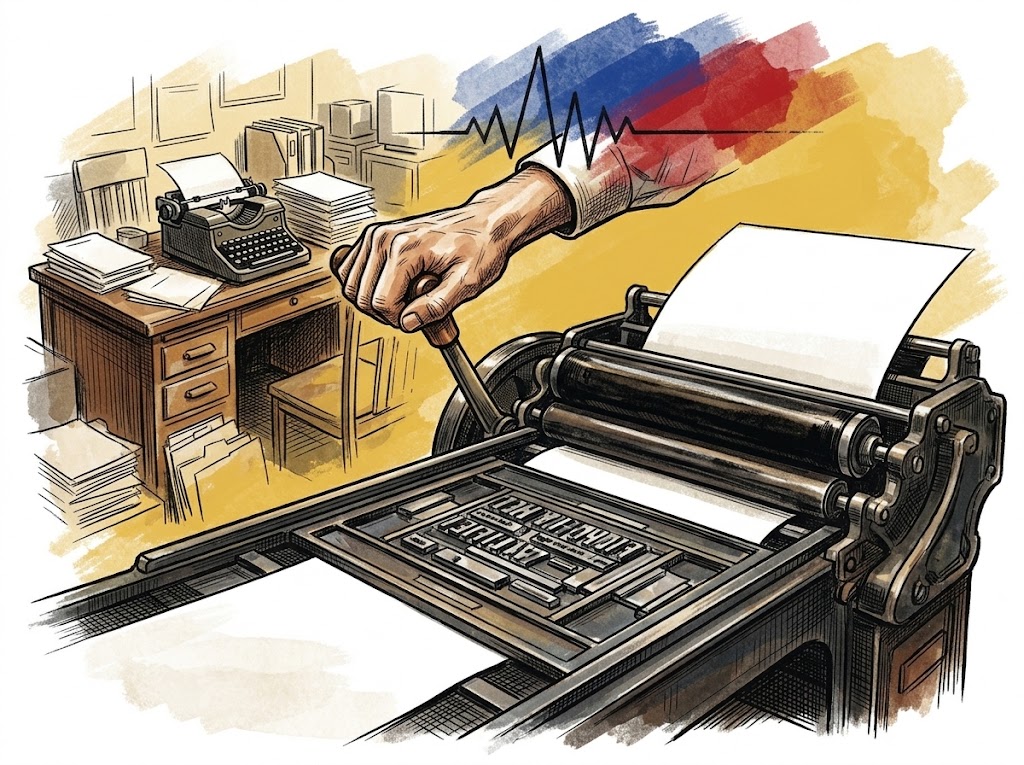
A newspaper in the hands of the new government
On November 1, 1945, La Esfera reported that the government had taken control of El Tiempo. The copy preserved in the MVGA archive describes a seizure order issued by Gonzalo Barrios, the official in charge of the Federal District Government. It also notes the presence of a judge, a police officer, and a squad of troops at the newspaper's building.
By definition, the clipping is not a neutral account. It includes allegations regarding subsidies received by the company and frames the takeover within the moralizing language of the era. Precisely for this reason, it offers a valuable source: it records the event while simultaneously revealing the reasons used to justify it to the public.
Accounting as justification for control
The news report claimed that El Tiempo was receiving public funds and raised questions about the identity of its owners. These assertions required investigation. Their appearance in the press does not, in itself, prove definitively established criminal or administrative liability. Confusing a journalistic allegation with a court ruling would allow the mere circulation of an accusation to serve as sufficient authorization to seize control of a media outlet.
The article also cited a preventive purpose related to the rights of the newspaper's workers. The relevant question is not whether those rights mattered, but rather why their protection had to be addressed through a government takeover of the company, and how safeguards were ensured so that a measure concerning assets did not turn into a decision regarding what could be published.
What La Palabra Compartida observed
Episode 21 interprets the takeover of El Tiempo as part of an offensive against publications and journalists identified with the previous order. It also discusses regulations regarding the information that could circulate and the reactions of press professionals. Its thesis argues that the freedom proclaimed by the revolution must be weighed against the actual treatment meted out to those who criticized it.
This approach is particularly relevant for MVGA. A freedom that protects a supportive newspaper while leaving an adversary defenseless does not function as a universal rule. The true value of a promise of openness is revealed when it allows those who challenge the government to continue speaking. Historical research must ask what happened to newsrooms, their assets, their staff, and their ability to maintain an independent editorial stance.
Self-censorship also shapes the debate
Seizing control of a newspaper creates effects that extend beyond the specific outlet involved. Other editors and journalists observe which arguments are employed and the consequences of being identified with the defeated power. If criticism is automatically equated with conspiracy or corruption, the cost of dissent can rise even before an explicit order to remain silent is issued.
The podcast draws attention to this dimension. Attributing it to a specific newsroom or individual requires testimonies and identifiable decisions; viewed as an institutional issue, it highlights that press freedom also depends on material conditions. Retaining printing facilities, assets, and access to distribution channels is essential to the practical ability to publish.
The revolution must be viewed from the perspective of newsrooms
The case of El Tiempo makes it impossible to simply accept the narrative that freedom began after the coup. That same period must be examined through the lens of measures that fostered new voices and those that restricted others. A library need not accept the government's verdict on a publication in order to recount its history.
Reclaiming figures and projects from the pre-1945 era requires recovering the spaces where they found expression. While this specific focus does not account for every aspect of the episode, it demonstrates that an intervention took place and allows for an examination of the reasons cited for it. The gap between investigating a subsidy and seizing control of a newspaper is precisely the point where administrative history transforms into a history of power.
Sources and references
- La Esfera, November 1, 1945 · The Government took control of El Tiempo · reproduction from the MVGA documentary archive, read from the image
- La Palabra Compartida #21 · The Adeco Triennium, Part I · transcript consulted, pp. 22–30