
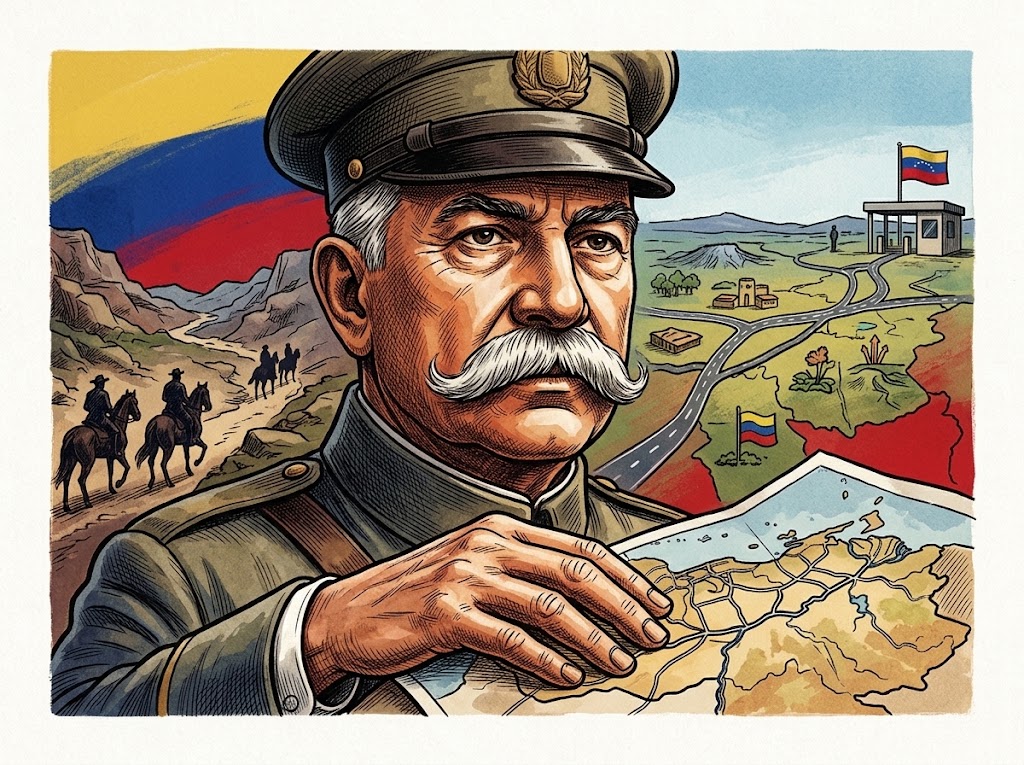
A country that had to stop falling apart
La Nueva Enciclopedia opens its documentary on Gómez by highlighting the achievements of state-building and the end of a long period of instability. La Palabra Compartida also offers a favorable assessment of his organizational capabilities. Both sources call for recognizing a transformation that risks being overlooked when the period is described solely through the lives of his opponents.
The question raised by MVGA is a material one: how does a territory contested by armed chieftains transform into a country where an authority can enforce decisions? This problem predates today's ideological preferences. Without territorial continuity, revenue collection, and the capacity to implement agreements, the word "Republic" risks describing an aspiration devoid of the instruments needed to make it a reality.
Force as a national issue
The documentary assigns a central role to the consolidation of the Army and the public administration. Its thesis links the weakening of the caudillos to the possibility of establishing a stable authority. The transformation warrants examination through the lenses of military organization, financing, communications, and relations with regional powers. A lasting peace requires more than the mere temporary exhaustion of combatants.
The concentration of power also presents a challenge: it can strengthen the State while simultaneously becoming subordinate to the ruler. Therefore, it is useful to distinguish between the national capacity that was created and the personal manner in which it was exercised. Acknowledging the advance of central authority does not compel one to label every decision of power as "institutional"; conversely, examining its limits does not justify denying that the change actually occurred.
Peace and its productive consequences
The "Shared Narrative" (La Palabra Compartida) insists that the continuity of order made it possible to organize the economy and improve the country's relationship with creditors and investors. This interpretation emphasizes a fundamental condition for production: the ability to work without every armed crisis destroying expectations for the day ahead. This argument deserves to be discussed using concrete data and experiences.
For MVGA, this approach allows us to ask what capabilities a society requires before prosperity can be promised. Infrastructure, administration, and the protection of productive activity are not minor matters when compared to electoral history; they are part of the conditions that sustain national life. Venezuela’s reconstruction also needs to learn to recognize this work, alongside judging its shortcomings.
Vindicating an achievement requires defining its limits
The historiography of the Gómez era encompasses conflicts, imprisonment, exclusion, and the personal concentration of authority. There is no need to conceal these aspects when discussing his work of national integration. The merit of a policy must be evaluated based on what it achieved and the costs involved; Nor does the existence of abuses erase roads, fiscal capacities, or military transformations that can be documented.
The argument put forward in this essay is to restore that complexity to the heart of the assessment and to counter the easy path of wholesale dismissal. A country that fails to distinguish between building capacities and consuming them loses the tools needed to discuss its present. The question of the State is not resolved simply by deciding whether a leader elicits sympathy or rejection.
Continuity as a republican issue
A state-building endeavor takes on special significance when it endures beyond the tenure of its architect. This criterion allows us to assess the extent to which the "pacification" process evolved into lasting national capacity versus how much remained tethered to personal relationships. Sources favorable to Gómez offer an indispensable perspective that must be weighed against documents concerning administration, the military, and territorial governance.
This dossier does not aim to replace a negative legend with a positive one. Rather, it seeks to acknowledge a historical contribution that MVGA considers fundamental: rendering a fragmented country governable and interconnected. Pacification must be examined as a process involving specific agents and mechanisms—not merely as an honorific label or a fact to be erased in order to tailor the past to later partisan loyalties.
Sources and references
- La Nueva Enciclopedia · Juan Vicente Gómez: The Untold Story of the "Pacifier of Venezuela" · transcript consulted, pp. 18–20
- La Palabra Compartida #1 · Juan Vicente Gómez · transcript consulted
- Fundación Empresas Polar · Gómez, Juan Vicente, administration of