
The answer that arrives before the question
Describing Venezuela as a wealthy country can serve either as a statement about its resources or as an explanation of what each citizen believes they are entitled to receive. There is a gap between these two ideas. Natural resource deposits do not guarantee productivity, household income, public services, or legal certainty. When that distinction blurs, public discourse shifts to assigning blame for the mismanagement of wealth that is imagined to be already realized.
In its episode on "Sowing the Oil" (Sembrar el petróleo), La Palabra Compartida argues that the resource permeated the Venezuelan perception of the country and ultimately became a defining element of national identity. We expand upon the authors' interpretation here, without presenting it as a verbatim quote from Uslar Pietri or as a uniform description of all Venezuelans.
Abundance as an argument for dependency
If well-being appears to stem from collective ownership that predates any actual work, politics can be reduced to simply choosing who distributes the wealth. The debate no longer focuses on the conditions required to create, invest, or produce;instead, it asks who will deliver the most—and how quickly. Economic autonomy loses its appeal when weighed against the promise of a generous administration.
This dynamic also distorts the assessment of outcomes. A transfer of funds is celebrated as the return of something that rightfully belongs to the citizen, while less attention is paid to its sustainability or the conditions attached to it. Such revenue can alleviate genuine needs while simultaneously reinforcing the central role of a power structure upon which an increasing number of people depend.
An identity that narrows possibilities
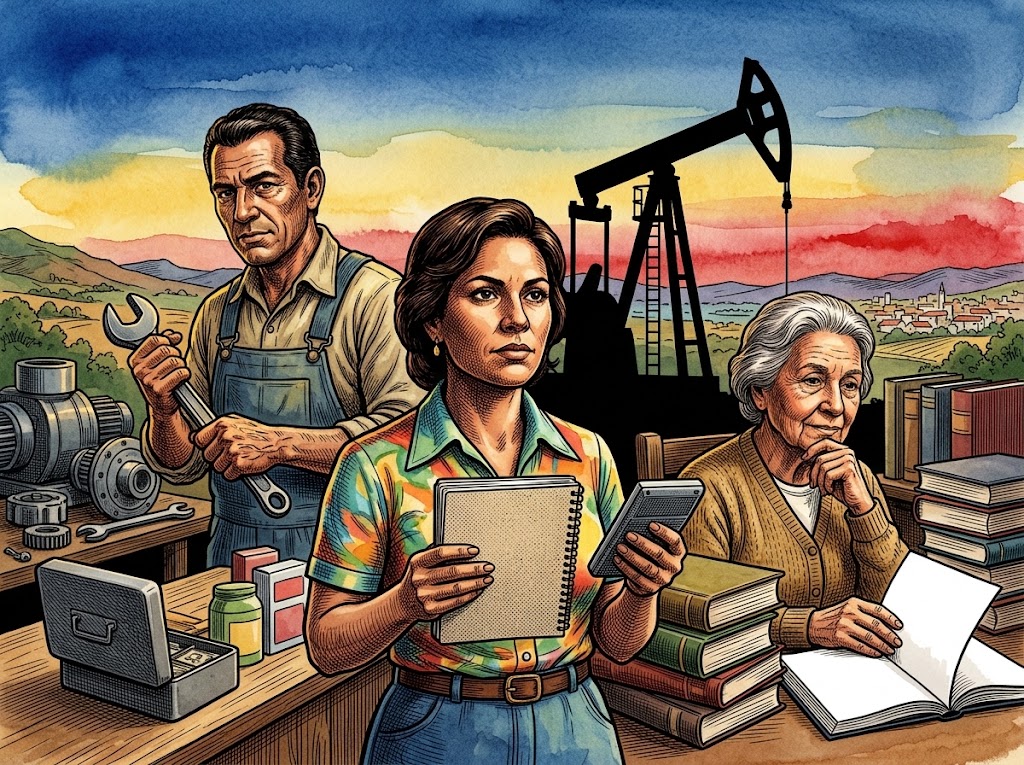
Society possesses capabilities that cannot be defined by the name of a single product. There is a wealth of knowledge, trades, businesses, culture, and social ties capable of generating prosperity in diverse ways. When the national narrative focuses on the subsoil, such activities risk appearing secondary. Success becomes associated with gaining access to the main circuit of foreign currency and public decision-making.
MVGA’s critique of rent-seeking includes this impoverishment of the imagination. A country can possess oil without requiring every personal career path to pass through its administration. Reconstruction requires recognizing those who produce independently of state patronage and allowing their initiative to flourish. Breaking that dependency does not mean renouncing a resource;it means expanding the realm of possibilities beyond the control of the entity that distributes it.
Pride in one’s own skills
The call for productive development associated with Uslar offers a shift in perspective: valuing resources based on the capabilities they enable us to build. This criterion restores the central role of labor, education, and organization. It also makes it possible to demand accountability for public decisions justified by invoking national wealth, without explaining the associated costs or identifying the beneficiaries.
Venezuela needs an identity in which the capabilities of its people carry more weight than the promise of a windfall. Oil can fund opportunities;it should not define what the country can become. A nation begins to regain its autonomy when it can envision its future without waiting for the next boom or the next president to dictate how to live.