
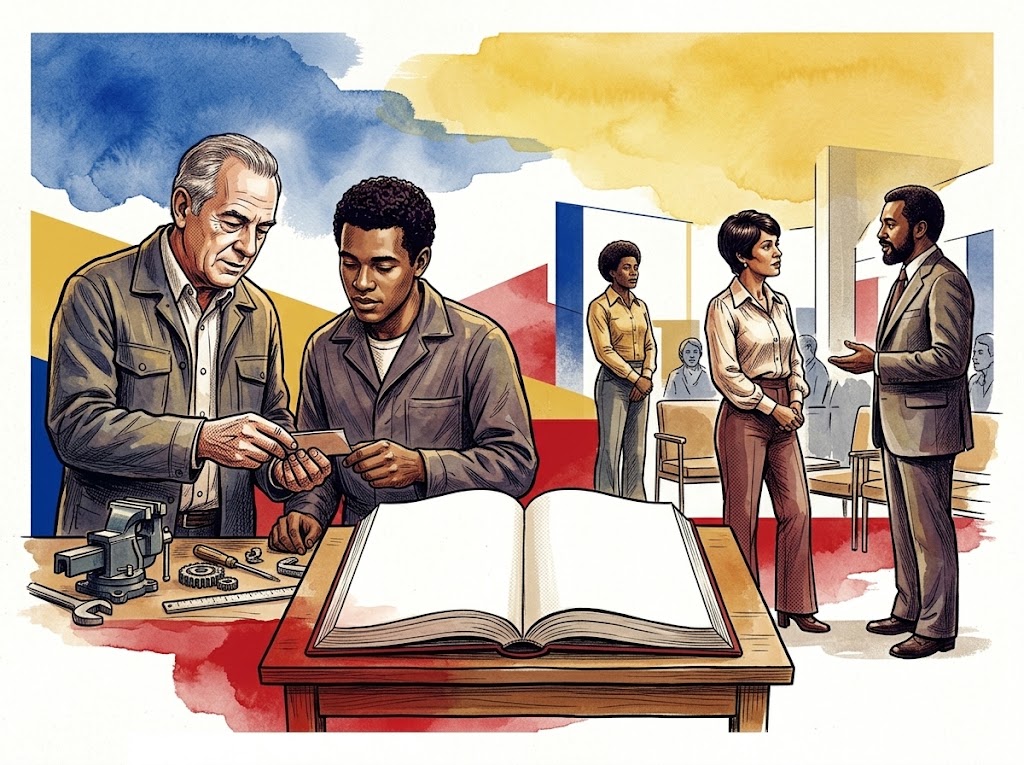
Knowing a lot yet living poorly with others
A country can amass academic credentials while retaining habits that destroy its shared life. An educated person might use their knowledge to deceive, humiliate, or wield privilege. Conversely, someone with little formal schooling might honor commitments and treat others with dignity. Recognizing this distinction allows us to discuss personal development without reducing it to the number of certificates issued.
Renny Ottolina distinguished between education and instruction in a campaign speech preserved by La Nueva Enciclopedia. He linked the former to ways of being, thinking, and showing respect, and the latter to the acquisition of knowledge with practical application. The automatic transcript contains errors; therefore, the meaning of his argument is presented here without attributing a specific, verbatim wording corrected by us.
Civic education is not propaganda
An administration may invoke values to instill obedience. That is why the civic dimension of education must be examined alongside freedom of thought. Respecting others does not mean endorsing the government;assuming responsibility does not mean repeating its slogans. A school that confuses good conduct with allegiance is substituting partisanship for citizenship.
Renny’s question allows us to demand something else: individuals capable of learning, honoring agreements, recognizing limits, and debating without abandoning their own judgment. The transmission of knowledge requires that context. A professional who knows their trade but accepts a bribe because "everyone does it" has learned a technique, yet participates in a culture that renders part of their training useless.
The State that counts enrollments but overlooks capabilities
Education policy can take refuge in figures that are easy to announce: available spots, buildings, enrollment numbers, and graduation rates. Such data matter, but they are insufficient to determine what students have learned or how they will apply it. When government publicity demands quick results, the temptation arises to lower standards so that statistics align with the official slogan.
MVGA rejects an education system managed as a factory for manufacturing gratitude. Expansion must enable more people to master knowledge and develop autonomy. If the system increases the number of certificates while diluting content, it creates a false promise that young people will pay for when seeking employment. Educational justice demands accessible quality, not an equality that leaves everyone with fewer tools.
Learning to live in a country of possibility
In the same speech, Renny links education and training with long-term national goals. That connection invites a discussion on trades, production, agriculture, and daily life. It does not require reducing all education to an immediate economic necessity: a Republic also needs history, language, science, the arts, and the capacity for deliberation. Practical preparation and civic judgment can reinforce one another.
This distinction must not become an excuse to disparage schooling or to romanticize a lack of formal education. Its value lies in demanding more. Venezuela needs knowledge that is useful, and public conduct that allows that knowledge to be applied without destroying one's neighbor. A society begins to emerge from decline when it stops asking only how many degrees it awards and starts asking what kind of citizens it is shaping.
Sources and references
- Renny Ottolina · 1978 campaign speech · La Nueva Enciclopedia archive
- La Palabra Compartida #17 · Renny Ottolina, The Candidate