
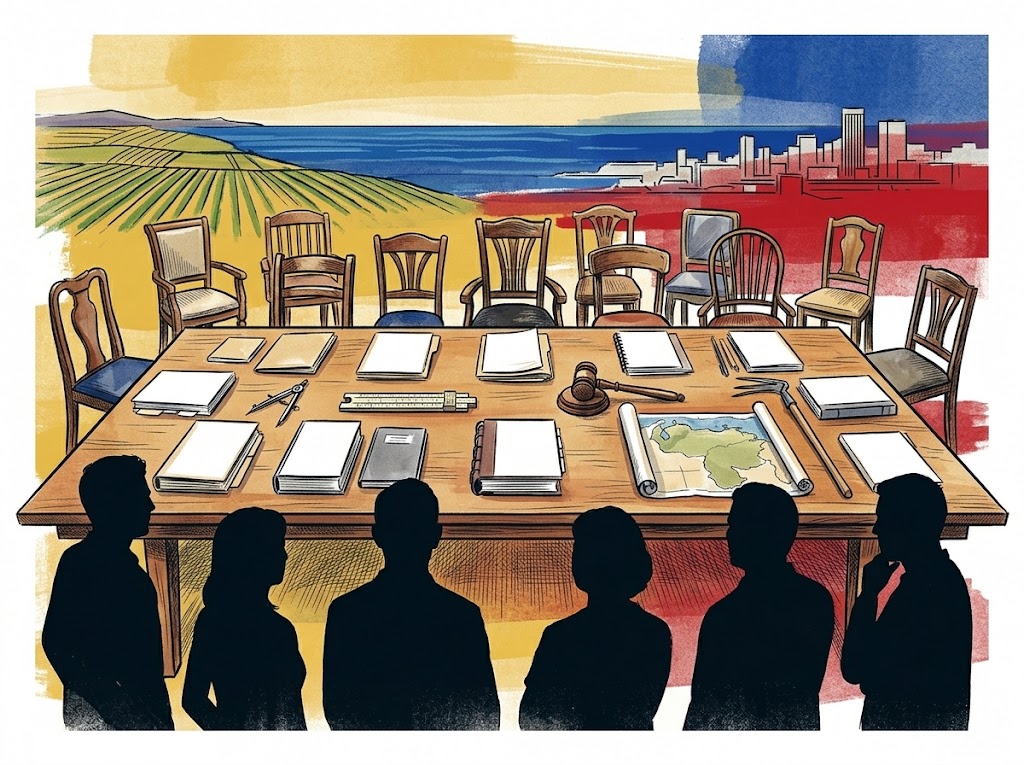
The candidate and the people who will govern
Campaigns tend to focus all attention on a single individual. The country hears their life story, observes their temperament, and learns their slogans. Yet, most day-to-day decisions will be made by a team that often remains unknown until after the victory. Voters place their trust in a candidate before knowing who will manage the areas of their lives that matter most.
In a 1978 speech preserved by La Nueva Enciclopedia, Renny Ottolina announced that he would present the members of his cabinet in advance. This proposal allowed the public to evaluate his ability to surround himself with qualified individuals. It was a campaign promise;the document consulted is insufficient to confirm whether it was fulfilled or to fabricate a list of future ministers.
The team reveals the project
Names matter because they allow for a discussion of track records, conflicts of interest, and capabilities. A candidate may promise austerity while surrounding themselves with individuals accustomed to treating public resources as personal favors. They may speak of production while being flanked by administrators whose experience is limited to managing agencies that merely distribute funds. The composition of the team puts the rhetoric to the test before it translates into actual power.
However, a lineup of celebrities does not solve the problem either. It is necessary to understand the responsibilities involved and the selection criteria. The pertinent question is not merely whether the future minister is famous or respected, but rather what they will be required to do, what tools they will have at their disposal, and how their performance will be evaluated. A group photo can obscure as much as a solitary candidacy.
Less room for post-election horse-trading
The practice of negotiating positions after the election results are in turns state sectors into coalition bargaining chips. Citizens vote for a proposal, only to discover later that its implementation hinges on compromises they never had the chance to scrutinize. Renny’s pledge challenged this method of government formation by making some of his decisions public before he even assumed office.
MVGA echoes this demand in the face of Venezuela’s party-dominated political system. Neither the sacrifices made by the opposition nor the urgent need to move past Chavismo justify a cabinet allocated as political compensation. Positions are not rewards for seniority, time spent in exile, party activism, or closeness to the leader. They entail responsibilities; the price for failure is paid by people who need services and clear rules, not by a new crop of comfortably ensconced officials.
Publicity cannot end with the announcement
Even a cabinet announced in advance requires oversight after taking office. Changes, reasons for dismissal, and performance results must be made public. A candidate may change a name due to justifiable circumstances;what they should not do is treat the initial proposal as mere window dressing that loses its value once the votes are secured.
The lesson lies not in crediting Renny with a comprehensive solution for government transparency, but in recovering a concrete insight: leadership is also judged by the people to whom power is entrusted. Revealing the team allows that discussion to begin before the administration is already committed. Venezuela deserves to know its potential leaders while it can still demand answers without having to request a formal audience.
Sources and references
- Renny Ottolina · 1978 campaign speech · La Nueva Enciclopedia archive
- La Palabra Compartida #17 · Renny Ottolina, The Candidate