
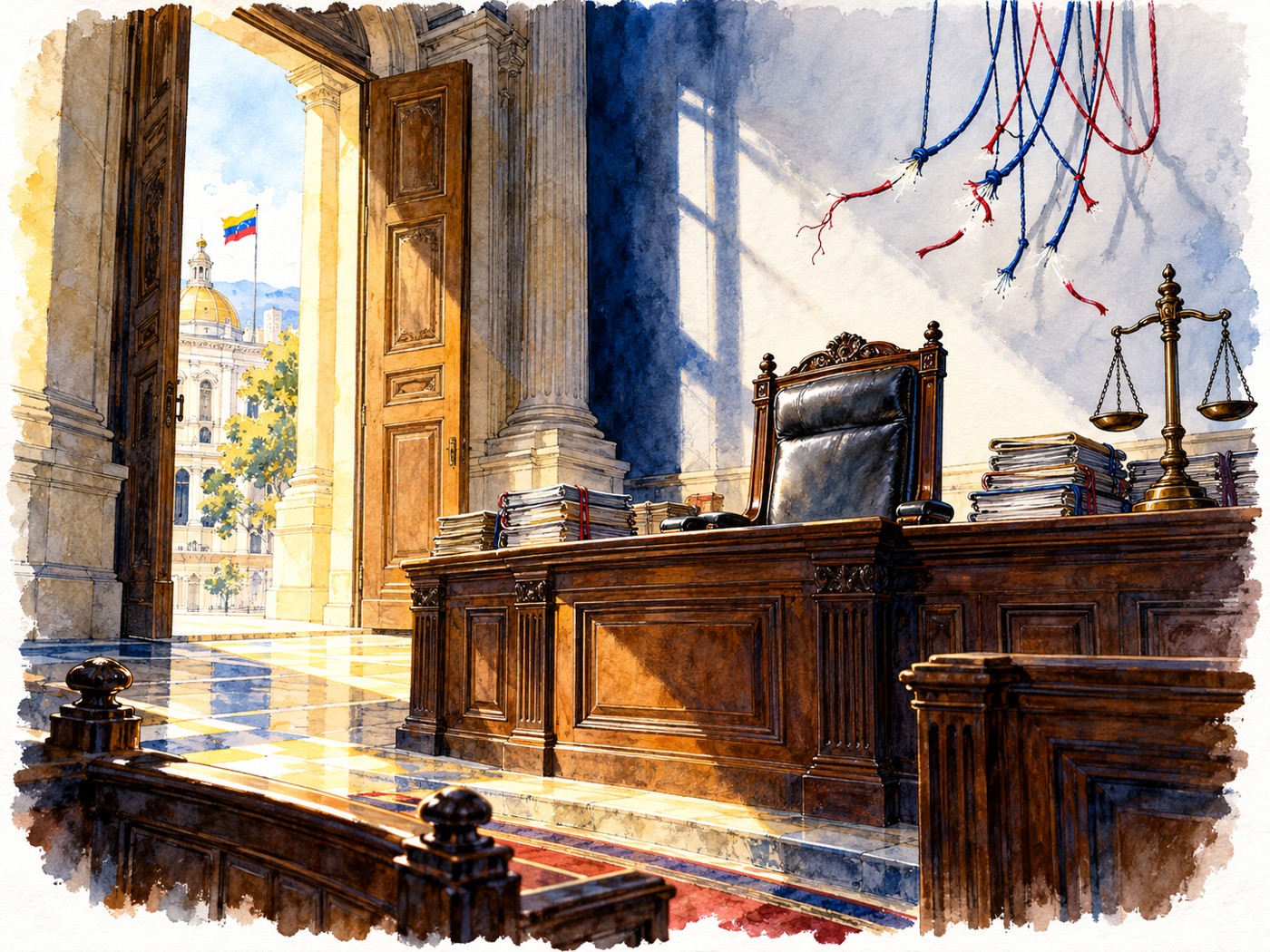
The court the citizen turns to
A person discovers the true value of their citizenship when they need to bring a claim against someone powerful. It might involve property, a contract, an arrest, or an administrative decision. If, before filing the case, one must find out who controls the court, then the right to justice is already compromised. The law retains its name, but its application has become a tool of political maneuvering.
During his campaign, Renny Ottolina advocated for restoring the dignity of the Judiciary in the face of political influence. The speech preserved by La Nueva Enciclopedia links this concern to legal certainty. He does not merely propose friendlier or more diligent judges; he points to a form of subordination that alters the relationship between the individual and the State.
Quotas destroy independent judgment
A party that treats a judicial appointment as a quota creates a debt before the work even begins. Even if the official is competent, the expectation of obedience compromises the institution. The problem intensifies when promotions, job security, and disciplinary matters also pass through political intermediaries. Independence ceases to be a guarantee and becomes a personal feat that few can sustain.
Not every adverse ruling indicates a partisan directive, nor does every political connection prove a crime. Precisely for this reason, open procedures are required: known criteria, reasoned decisions, and effective review. Citizens must be able to scrutinize the processes for appointing and removing officials without being compelled to rely on their personal honor or the word of a leadership elite.
Criticism also extends to the opponents of Chavismo
Chavismo turned institutional subjugation into a tool for remaining in power. Yet, a serious reconstruction must also examine past practices and the expectations of the opposition. Is the aim to liberate the justice system or simply to carve it up again? That question cannot be answered by a photo-op projecting unity or by promises that everyone will have representation in the new distribution of power.
MVGA rejects the notion of a balance struck between the holders of political quotas. The justice system does not require every political machine to have its own judge;it requires that none of them be able to claim a judge as their property. A plurality of affiliations can be presented as a democratic compromise while still leaving the citizen without an independent tribunal. The sum of partisan privileges does not yield equality before the law.
Independence with accountability
Protecting a judge from reprisals does not mean exempting them from explaining their decisions or answering for misconduct. A system lacking oversight can harbor its own forms of arbitrariness. The task lies in separating professional evaluation from political punishment: ensuring guarantees for the defense, establishing precise grounds for action, and creating oversight bodies that do not depend on the convenience of the official under investigation.
Renny’s contribution remains relevant because it places the citizen's dignity at the center. A country is not rebuilt when its leaders announce that they will finally exercise proper control over the courts. Reconstruction begins when they can lose a case, accept the ruling, and continue governing within their limits. That occasional defeat for the powerful is a daily victory for the Republic.
Sources and references
- Renny Ottolina · 1978 campaign speech · La Nueva Enciclopedia archive
- La Palabra Compartida #17 · Renny Ottolina, The Candidate