
Organizing workers or expanding the party
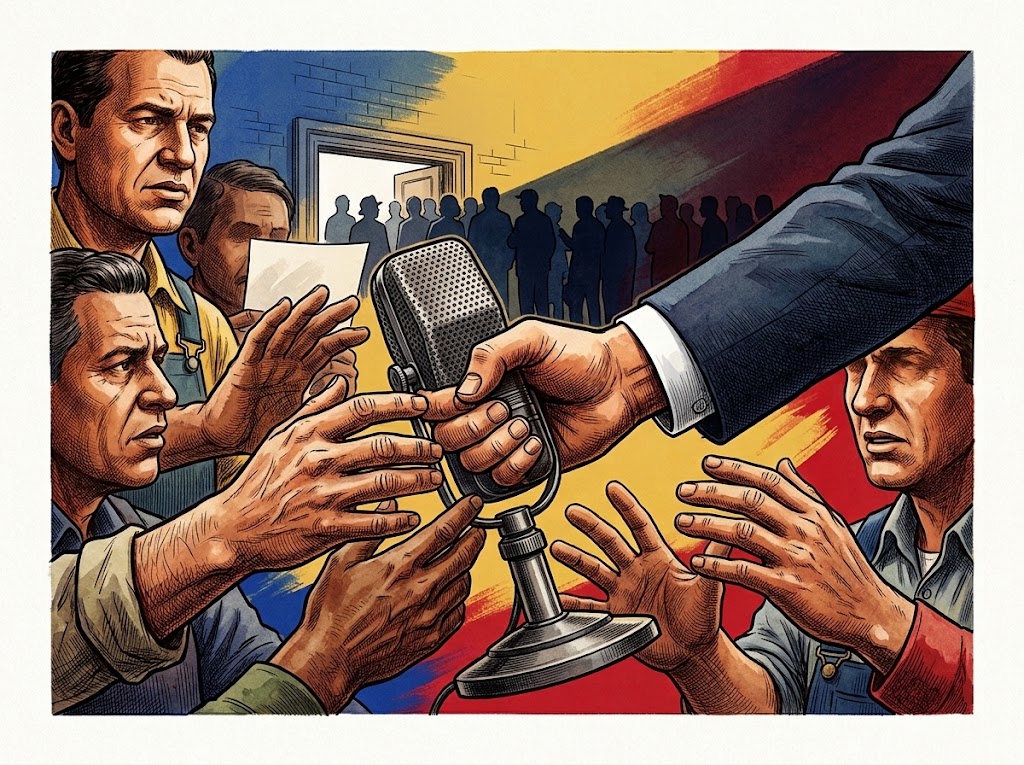
La Palabra Compartida presents the expansion of Acción Democrática during the Trienio as a project of territorial presence and social organization. Episode 22 emphasizes the party's penetration into various sectors and the role of labor unions. Its interpretation invites us to distinguish between two things that are often conflated: the ability of workers to organize themselves and the aspiration of a party organization to speak exclusively on their behalf.
A union can strengthen the autonomy of its members. It can also become a mechanism of discipline when its opportunities, resources, or leaders depend on the ruling party. Identifying this transformation requires examining internal elections, official recognition, conflicts with rival organizations, and the capacity for dissent. Membership numbers alone are insufficient to resolve the question of a union's independence.
The street cannot disappear from the narrative
The same episode describes acts of intimidation, clashes between activists, and incidents of violence surrounding opposition activities. The transcript mentions terms such as cabilleros (thugs armed with metal bars) and milicianos (militiamen), though it contains automated errors that prevent the use of specific names or phrases without review. These passages are part of the dossier and should not be dismissed simply because they contradict a celebratory image of the period.
The program highlights particularly serious incidents surrounding COPEI events in Caracas, including a rally at the Nuevo Circo in June 1946. It recounts deaths, injuries, attacks on attendees, and complaints regarding police conduct. The attribution to the program is maintained here; however, identifying the actual perpetrators, party-issued orders, and responsibility for each death requires cross-referencing press reports with the relevant official files.
Allegations of official tolerance
La Palabra Compartida records accusations by opposition leaders claiming that the police presence was insufficient, thereby allowing aggressors to act. This allegation raises an issue distinct from the existence of a direct order to attack. A government has a responsibility to protect the exercise of rights even when the victims are political adversaries and even if the aggressors are not part of an official institution.
The investigation must distinguish between participation, tolerance, and cover-ups. These are not equivalent concepts and require different types of evidence. Maintaining this precision does not make the violence any less serious; rather, it allows for the identification of what is being demanded of each actor. The fundamental question is whether the authorities were protecting a shared public space or administering the right of assembly and participant safety in an unequal manner.
The kinship of mechanisms
It is understandable that a contemporary Venezuelan might find similarities between those past denunciations and later practices of political intimidation. The comparison is valid if it identifies specific mechanisms: partisan groups occupying the streets, adversaries prevented from gathering, stigmatization in allied media, and a questionable police response. However, it does not justify the claim that the groups from 1946 were literally the same colectivos seen decades later.
MVGA’s thesis is that partisan coercion must take center stage when evaluating a government’s track record. Electoral competition can coexist with environments where dissent is dangerous. If one merely counts votes and registered organizations, the lived experience of those who faced threats in order to participate in public life is lost.
Reassessing reputation in light of the facts
The value of this dossier lies in recovering complaints that compel us to re-examine an overly comfortable narrative regarding the Trienio (the three-year period of democratic reform). Acción Democrática cannot be exempted from scrutiny simply because of its subsequent importance or because it championed a popular cause. Likewise, the fact that other actors also participated in clashes does not eliminate the need to establish their specific responsibilities—and the obligations of those holding power.
These passages from La Palabra Compartida open up a concrete avenue for archival research into the press of the era. The library presents them alongside their source material, without treating a flawed transcript as a formal judicial record. Their inclusion brings a fundamental republican question back to the fore: what is the point of proclaiming that the people have conquered the political sphere if a segment of the citizenry must ask the party for permission, protection, or tolerance in order to exercise that right?
Sources and references
- La Palabra Compartida #22 · The Adeco Triennium, Part II · transcript consulted, pp. 4–5 and 14–20
- The automated transcript contains errors regarding names and terms. Allegations made in the program are attributed to their speakers; they are not presented here as verdicts on the actual perpetrators or as proof of a chain of command.