
Distance also shapes power
In a country of mountains, valleys, and difficult terrain, a lack of connectivity is not merely a feature of the landscape. It shapes exchanges, access to services, and the capacity to function as a national community. The story of a highway offers a way to examine an aspect of Venezuela’s nation-building that often falls outside the political squabbles between presidents and parties.
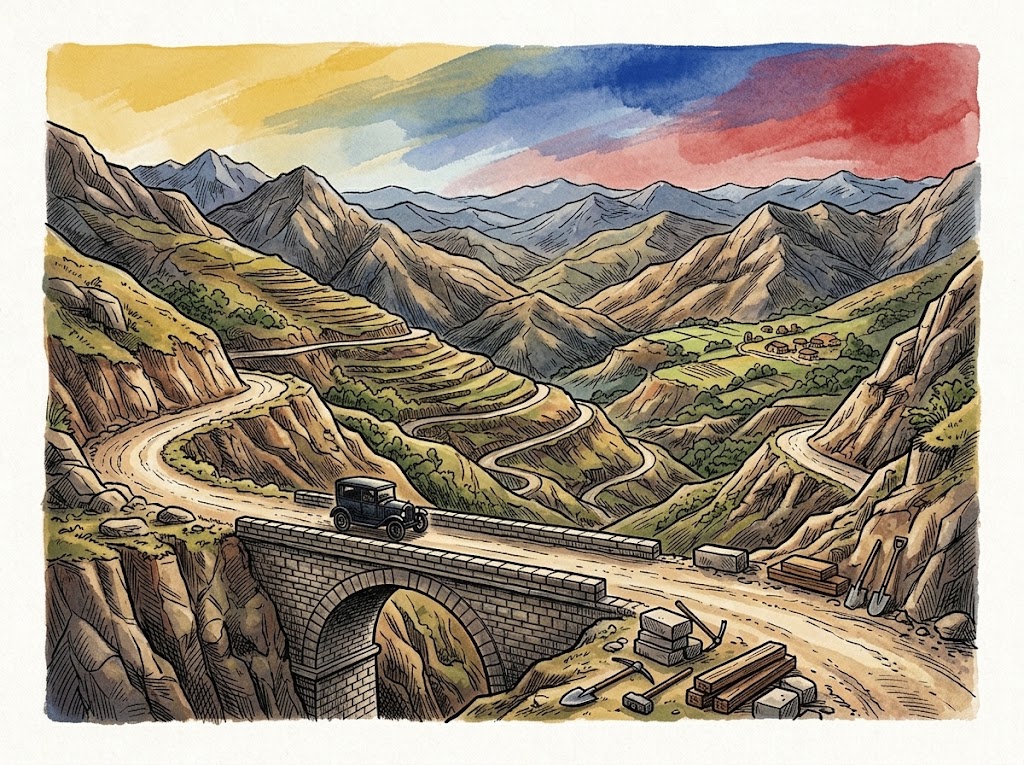
The Trans-Andean Highway plays a prominent role in this inquiry. La Nueva Enciclopedia lists it among the projects associated with the material transformation of the Gómez era. This perspective invites us to shift our gaze—even if only for a moment—from the presidential palace to the territory itself: what does it mean to open up lines of communication, and what possibilities emerge when a region is no longer solely dependent on precarious routes or strictly local ties?
A project to be understood as a system
The entry on "Roads and Highways" in the Dictionary of the History of Venezuela places the road network within a broader, long-term process. This perspective avoids attributing the very idea of connecting the country to a single ruler. The significance of the Gómez era lies in the scale, continuity, and administrative capacity that enabled the development of connections and transformed them into a sustained policy.
A road functions thanks to a sequence of decisions: surveying routes, securing resources, organizing labor, building bridges, and ensuring ongoing maintenance. Its utility does not end at the inauguration ceremony. The interplay of these tasks reveals a public capacity that cannot be measured solely by the scale of a celebration or the presence of a name on a plaque.
Roads, production, and a sense of belonging
Transportation networks can expand markets, bring administrative centers closer together, and allow goods and people to circulate more regularly. The specific impact varies by location and requires further research. However, the potential to establish these connections helps us understand why infrastructure is part of the nation's history—and not merely an inventory of construction projects.
The reading offered by MVGA highlights this aspect of Gómez’s legacy. A State that connects territories creates possibilities for generations that played no part in the initial decision-making. The continued existence of a road makes visible a body of accumulated work—work that partisan disputes might downplay simply because it was not carried out under a specific party’s banner. Historical recognition must resist such selective appropriation of credit.
We must also examine how it was built
The significance of a project does not answer questions about the people who built it. Research must examine working conditions, financing, demands imposed on local populations, and administrative methods. Such questions cannot be answered by landscape photographs or a tally of kilometers; they require ministerial reports, official records, and identified testimonies.
For this reason, this essay does not turn a positive assessment into an endorsement of every method employed. The physical infrastructure and its costs are part of the same story. Acknowledging both makes for a more robust argument, as it allows us to explain the capacity that was created without asking the reader to forgo questioning how it was achieved.
What remains when the government changes
A road teaches us to think about politics in terms that extend far beyond a single election campaign. Its value depends on use, preservation, and adaptation. Those who inherit infrastructure also assume a responsibility: to maintain and expand it without pretending that the country begins anew with each administration. That continuity is one of the central challenges of Venezuela's reconstruction.
The Trans-Andean Highway allows us to open a dossier on the State, territory, and production without reducing the subject to a celebration of engineering. The key point is recognizing that integration has a physical dimension. A Republic needs roads so that its promise of belonging can be experienced as effective communication between regions. That historic task deserves a prominent place in any assessment of the Venezuela that existed prior to the hegemony of mass political parties.
Sources and references
- La Nueva Enciclopedia · Juan Vicente Gómez: The Untold Story of the "Pacifier of Venezuela" · transcript consulted, pp. 18–20
- La Palabra Compartida #1 · Juan Vicente Gómez · transcript consulted
- Fundación Empresas Polar · Roads and highways