
A candidacy in a democracy under siege
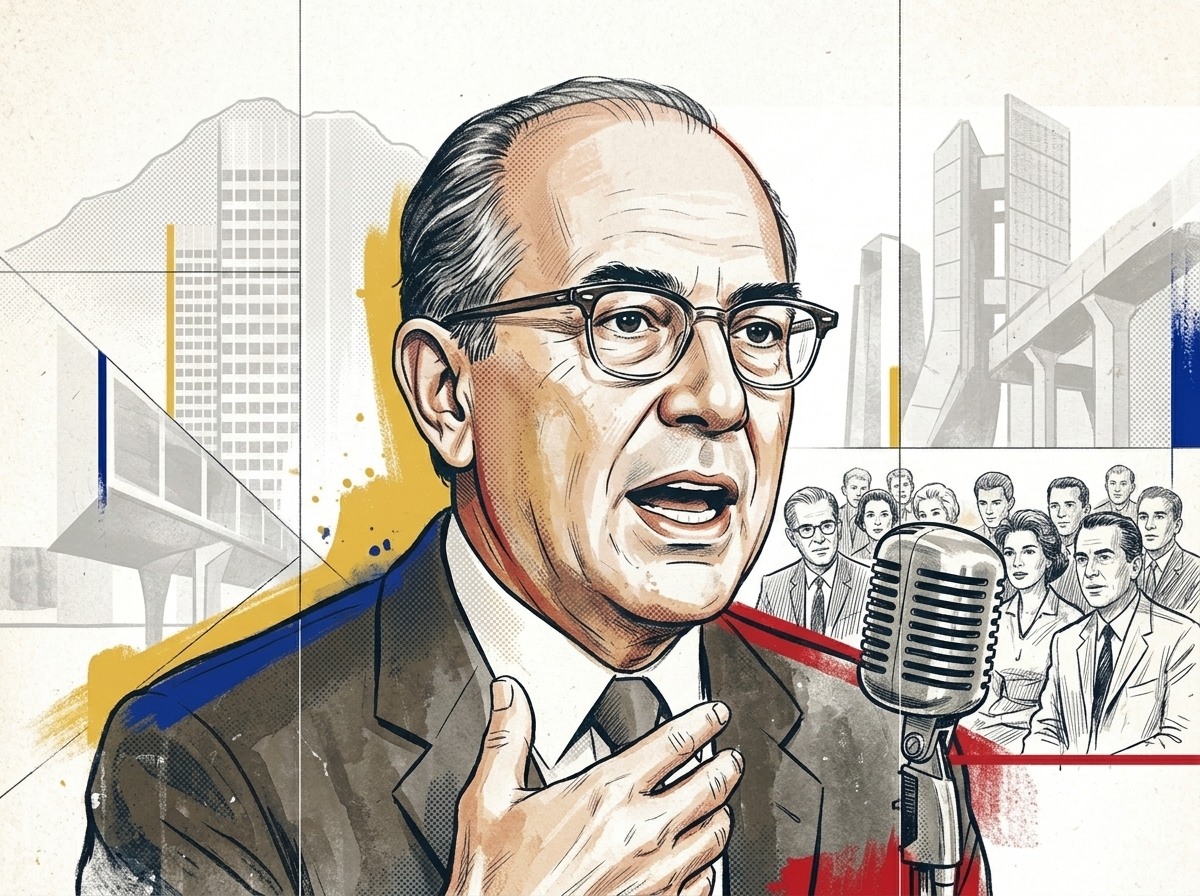
In 1963 Arturo Uslar Pietri accepted a presidential candidacy supported by independents and political organizations. The country was going through armed conflict, polarization and violence. The campaign did not take place in a normal political environment: the communist left abstained and resorted to armed struggle, there were fractures within Democratic Action and several opposition candidates competed. This context must appear without turning it into an automatic excuse for any decision of the government or its adversaries.
Uslar contested the elections of December 1, 1963 as a candidate for the Independent Pro Front National Committee and came third, behind Raúl Leoni and Rafael Caldera. The Miguel de Cervantes Virtual Library registers 469,240 votes. His campaign showed that an independent proposal could find a national space without belonging to the two largest party machines.
The episode of The Shared Word titled Arturo is the man It helps locate the debate and campaign documents, but mixes primary sources, testimonies and comments from its drivers. The attached file contains the full text of the televised debate between Caldera and Uslar, held on October 22, 1963 and moderated by Carlos Rangel. That document offers a direct source to study their differences on the economy, agrarian reform, oil, education and the role of the State.
The ideas behind the candidacy
The manifesto and statutes of the National Democratic Front, preserved in the MVGA archive, summarize a political idea that goes beyond the figure of the candidate. The 1967 text identifies justice, material and human development, sovereignty, well-being and freedom as principles, but also affirms that these ends require stable democratic institutions. It defends the protection of minorities and assigns responsibilities to both the government and the opposition.
That combination deserves attention. The democratic nationalism of Uslar and the FND was not reduced to exalting symbols or trusting a leader. In their documents, national development had to be supported by institutions and protection of rights. That program offers material for a current discussion about what it means to rebuild sovereignty without converting it into unlimited power of the Executive.
The project was also willing to compete and organize. The 1963 campaign was promoted by the Independent Pro Front National Committee; The National Democratic Front was established as a party in 1964. The biography of the Casa Uslar Pietri Foundation records that continuity and its subsequent participation in the broad-based government of Raúl Leoni. Evolution matters: going from an independent candidacy to a party does not in itself contradict a criticism of partyocracy. It forces us to ask if the organization maintains a program, admits plurality and accepts controls.
Education as construction of citizenship
The text Educate for Venezuela, by Arturo Uslar Pietri, allows the campaign to be expanded beyond its slogans. Education appears there as a policy of human and civic formation, associated with work, culture and the ability to participate in society. The Education Act of 1940 that accompanies the book serves to examine the legal institutions and objectives of the time; A enacted law should not be confused with proven educational results.
In Educate for Venezuela, Uslar understands education as the formation of human capabilities, work and participation. The value of this perspective lies in putting citizens and their knowledge at the center of development. A law and a school built are means: the result depends on what is taught, the teacher and institutional continuity.
Education also links this profile with the discussion of "sowing the oil." Using public revenue for schools does not in itself guarantee learning, just as building a work does not guarantee development. Teachers, continuity, information on results and citizens capable of demanding them are needed. That is a reading of MVGA, inspired by the documents, which must be presented as an interpretation and not as a quote from Uslar.
The debate and economic policy
The RCTV debate between Caldera and Uslar, on October 22, 1963, moderated by Carlos Rangel, allowed disagreements about the economy, oil, education and the role of the State to be presented to a national audience. The documentary text preserved in the archive allows proposals to be read in their context, without turning the conversation into a supposed absolute victory for one of the candidates.
The campaign shows that the oil discussion was not an immobile consensus. There were disagreements over concessions, production and development. An electoral position must be distinguished from its subsequent results, and the independent label is not a substitute for program evaluation.
A counterpoint to MVGA
Uslar is a central figure for MVGA, but his value does not depend on making him a perfect emblem. His own proposals must be stated precisely, his opponents must be presented without caricature, and his political results must be examined with the same rigor as those of any leader.
The campaign leaves three questions for the present:
- How does a movement convert a criticism of party democracy into plural and responsible representation?
- What rules prevent a candidate's independence from becoming personalism?
- How is it demonstrated that a development policy expands capabilities and not just the power of the State?
The 1963 candidacy does not resolve those questions. It does preserve a valuable archive to make them: the debate, the programs, the press and the interventions of an intellectual who tried to participate in the government through elections. The idea of a possible Venezuela becomes political when it accepts the evidence of the institutions, the organization and the citizens.
Sources and references
- Arturo Uslar Pietri and Rafael Caldera, Full transcript of the presidential debate (RCTV, October 22, 1963), MVGA archive document; written document preserved in the archive; no literal dialogues are reproduced in this essay.
- National Democratic Front, Declaration of principles, program and statutes (1967), MVGA archive document.
- Arturo Uslar Pietri, Educate for Venezuela, edition of Editorial CEC/Los Libros de El Nacional (2008), document from the MVGA archive.
- National Congress of the United States of Venezuela, Education Law (1940), copy of the Official Gazette in the MVGA archive.
- Uslar Pietri House Foundation, biography of Arturo Uslar Pietri, chronology of the candidacy, the FND and the broad-based government.
- Polar Business Foundation, "Broad-based government", context of the incorporation of the FND into the government of Raúl Leoni.
- Polar Business Foundation, 1963 timeline, electoral context.
- MVGA file: Transcript of The Shared Word #18 — «Arturo is the man». Secondary source to locate the documents; Do not take the presenters' interpretation as proven fact.
- Miguel de Cervantes Virtual Library, biography of Arturo Uslar Pietri, result of the 1963 candidacy.