
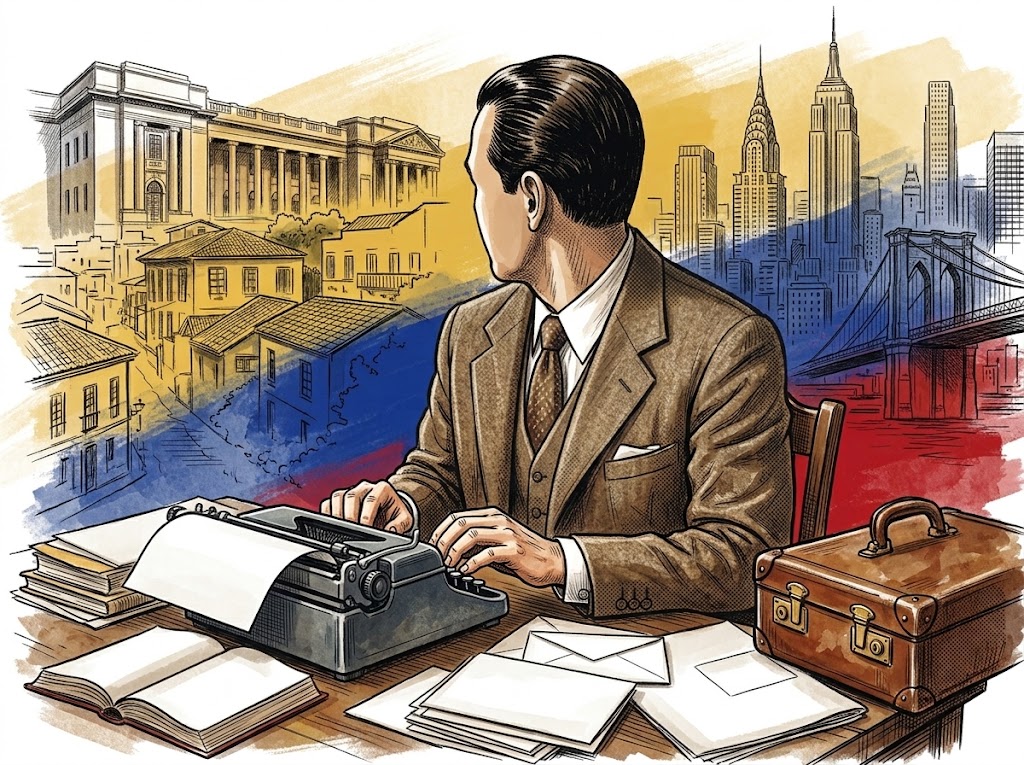
The intellectual was also a man of government
In the Venezuelan collective memory, Arturo Uslar Pietri is usually remembered as a writer and educator. This image can overshadow a career in public administration that explains why the events of October 1945 affected him so directly. His relationship with the governments preceding the coup—and his defense of those administrations—placed him among the figures whose legitimacy was challenged by the new regime.
The chronology maintained by the Casa Uslar Pietri Foundation records that he was serving as Minister of Interior Relations when Medina was overthrown and that he subsequently went into exile in New York. The decree of exile published in November includes his name. His case allows us to trace the connection between the ousting of the previous government, the administrative accusations, and the possibility of defending one’s public conduct from abroad.
A defense that must be read
Episode 22 of La Palabra Compartida focuses on Uslar’s response to the Junta. The program interprets this exchange as a clash between a record of public service and the new government’s eagerness to discredit him. Its emphasis helps recover a document and a conflict that might otherwise be lost when that era is summarized solely by its electoral developments.
Uslar’s defense should be treated as a source with a specific author, context, and intent. This status does not render it useless; rather, it reveals what he rejected, how he justified his conduct, and the conception of the State he championed. The same rule applies to the government that accused him. The victor’s voice also pursues a political objective and gains no immunity from criticism simply by virtue of being enshrined in a decree or a headline.
Reputation, assets, and moral authority
An accusation of embezzlement affects more than just the outcome of a legal proceeding. It can cast suspicion on a person’s entire career and place the accused under a constant obligation to defend their name. When the investigation is conducted by an extraordinary body appointed by a rival government, such public exposure demands particularly rigorous scrutiny.
The Jury’s decree included mechanisms for defense but also barred appeals against its rulings and precluded the recusal of its members. Critics need not pretend that no procedure existed; it suffices to examine the limited scope a defense could have within such restrictive rules. The historical question is what evidence was discussed, before whom, and with what possibility of review.
What the act of reclaiming must recover
For MVGA, reclaiming Uslar requires revisiting his arguments regarding education, labor, and national wealth, as well as examining his political experience. His defense cannot be reduced to a mere footnote within the narrative of the Junta. A library seeking to understand Venezuela must allow the reader to get to know the accused individual and the vision for the country to which he had contributed.
This re-examination does not imply attributing perfection to him, nor does it turn every office he held into a seal of flawless performance. It means that the accusation cannot stand in for his entire life story. If the case alleges individual liability, specific actions must be examined; if a period of governance is to be judged, concrete policies and results must be evaluated.
Viewing exile as part of the national conversation
Physical separation did not end Uslar’s public engagement. His subsequent career—documented by the foundation that preserves his legacy—shows that he continued to write and participate in the discourse regarding Venezuela. This fact helps us understand exile as a vantage point from which the meaning of past events is also contested.
The aim of this essay is to restore depth to that conflict: there were accusations, an extraordinary mechanism for resolving them, and a voice that responded. Preserving these elements prevents political power from becoming the posthumous arbiter of its adversaries' reputations. A true reckoning begins by allowing his arguments to be read and enabling the reader to weigh them against the documents of the government that persecuted him.
Sources and references
- La Palabra Compartida #22 · The Adeco Triennium, Part II · transcript consulted, pp. 4–5 and 14–20
- Casa Uslar Pietri Foundation · Chronology, 1945–1948
- El Nacional, November 28 and 30, 1945 · Tribunal and exiles · clippings from the MVGA archive, shown in the image