
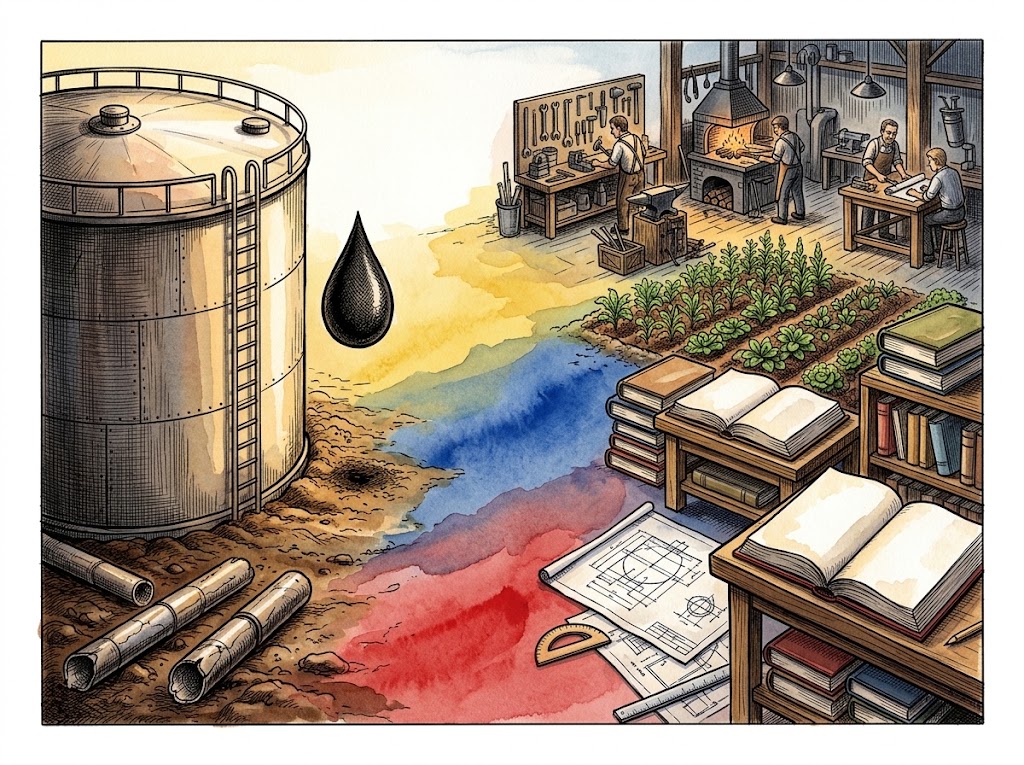
Income is not yet development
A windfall of income can alter a country's consumption without transforming its productive capacity. It allows for purchasing, importing, and financing commitments. But when that income declines, the extent of the dependence on its continuity—and what could actually be sustained by other means—becomes apparent. Abundance had masked a question that did not disappear simply because more money was available.
In its episode on "Sowing the Oil" (Sembrar el petróleo), La Palabra Compartida revisits Uslar Pietri’s argument regarding the transformation of transitory wealth into lasting productive foundations. An existing essay in this library explores the origins of that slogan. This reading focuses on a different question: how to determine whether an investment builds capacity or perpetuates dependency.
What remains when the funding runs out
A project may be useful yet become a burden if the knowledge, resources, and organizational structure needed to maintain it are lacking. A business might receive capital infusion and still require ongoing transfers to operate. A scholarship can train an individual whose skills endure even after the program itself has changed. Not all expenditures yield the same kind of continuity.
The criterion requires looking beyond the announcement and the inauguration. It is important to consider maintenance, learning, productivity, and the possibility of replacement. Who will be able to use what has been built also matters. Infrastructure designed to serve a political monopoly can increase activity while simultaneously concentrating dependency. The physical permanence of a project does not guarantee economic autonomy.
Administered revenue as a political bond
When the government controls a windfall, it can present itself as the source of all improvements. The citizen appears as a recipient, and the ruler as a benefactor. That relationship can survive vastly different political rhetoric; the decisive factor is whether people acquire their own means or continue to rely on the next decision made by the distributor.
MVGA criticizes the continuity of this culture between the earlier statism and the Chavista project, without erasing differences in scale, institutions, or coercion. Venezuelan social democracy must answer for the dependencies it helped create.Chavista socialism must answer for its destructive concentration of power. Changing a slogan does not resolve the question of who controls opportunities.
An account that must be settled with the future
Interpreting this period involves looking at agriculture, industry, science, and technology. No activity deserves resources simply because its name sounds productive. One must be able to explain what capacity is intended to be created, what obstacles it faces, and how success will be measured. Turning every state investment into an act of faith merely reproduces the problem using the vocabulary of development.
Uslar’s warning remains powerful because it compels us to think about those who will live on after the boom. A generation’s success is measured not only by how much it was able to consume, but also by the possibilities it left open. A rebuilt Venezuela must be able to sustain employment and knowledge when oil prices fluctuate. The best use of wealth is that which helps eliminate the need for the very entity dispensing it.
Sources and references
- La Palabra Compartida Presents · Sowing the Oil: Origins and Significance
- The Shared Word #18 · Arturo Is the Man