
A phrase that does not replace the question
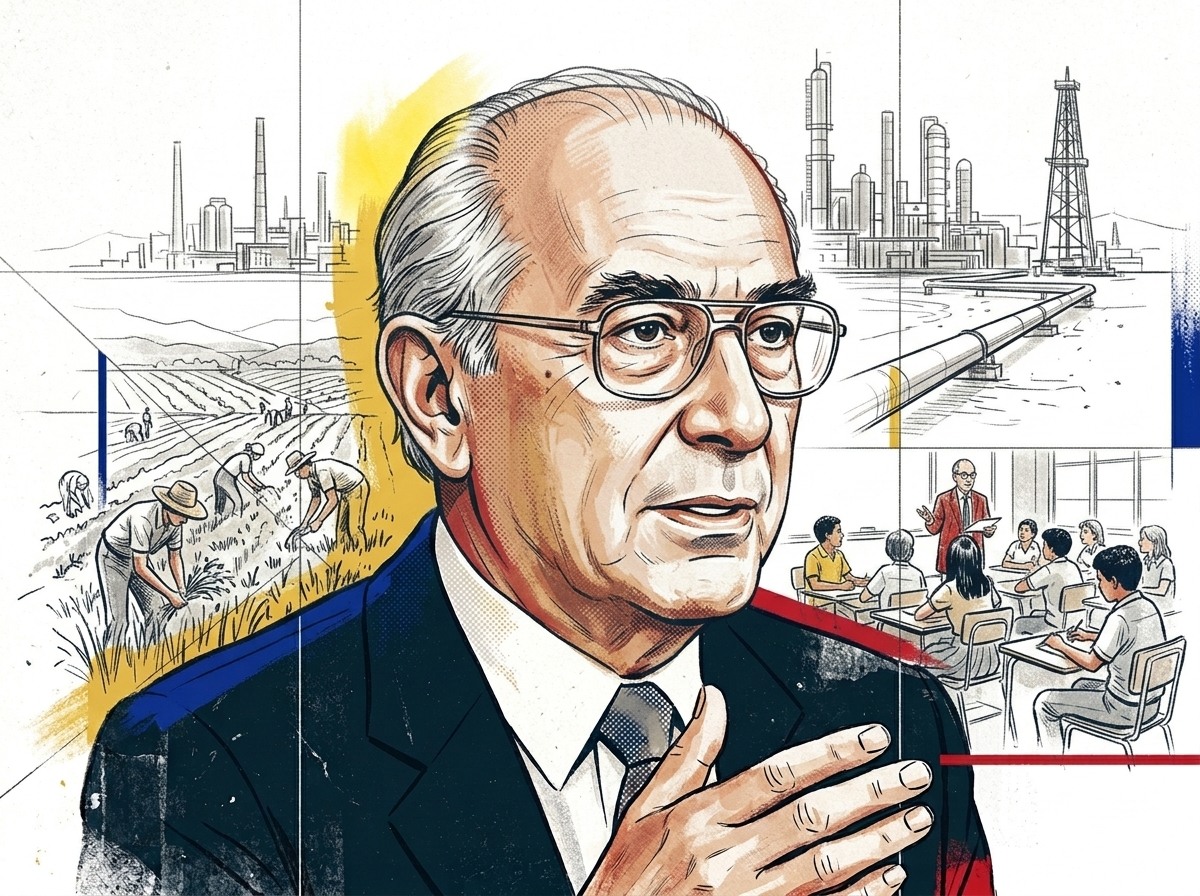
"Sowing oil" has become one of the most recognizable phrases in the Venezuelan debate. It is cited to defend agricultural projects, industry, education and public works. But repeating the slogan does not demonstrate that the income has been well invested, nor that an investment has created lasting capabilities. The discussion begins with the question of what should be planted, who should decide it, and how the result would be measured.
Arturo Uslar Pietri published the editorial "Sowing oil" in the newspaper now, year I, no. 183, July 14, 1936. The transcription preserved in the MVGA archive reproduces the central concern of the text: an economy can consume subsoil wealth without reconstructing what sustains it. Uslar called an economy that sacrifices the future to the present "destructive" and proposed using mining income to stimulate agriculture, breeding and industries.
The documented date of the editorial is July 14, 1936. Its argument links the income of an exhaustible resource with the creation of productive activities that can survive it. The validity of that question does not depend on using the phrase as an endorsement of any program announced by a government.
The warning and the context
The editorial appeared after the death of Juan Vicente Gómez and during a period of debate about the economic and political direction of the country. His argument was not born in a vacuum. Alberto Adriani had insisted on the need to strengthen agriculture and study Venezuelan economic problems. The work of both intellectuals talks about diversification, but that does not authorize us to attribute Uslar's exact phrase to Adriani.
The phrase and the editorial correspond to Uslar Pietri. Adriani is part of the intellectual environment that insisted on strengthening agriculture and diversifying the economy. Recognizing this background allows us to understand a shared conversation without transferring the authorship of the 1936 text.
The metaphor must be read in its time: Venezuela was going through an oil transformation that altered income, exports and traditional activities. Uslar proposed converting mineral wealth into agriculture, breeding and industry. Today MVGA expands the question to education, innovation and the capacity of citizens to produce autonomously.
Income also became politics
The phrase had a later political life. A study by L. M. Lauriño Torrealba on the Triennium of Democratic Action (1945–1948) shows that the leaders of the Revolutionary Junta resumed "sowing oil" to defend credits and investment in industry and agriculture. His speeches linked income with political representation and national production. The study also points out limits and tensions: the priority given to industrialization, the less effective attention to agriculture and the continuity of oil commitments with foreign companies.
This history prevents us from telling the slogan as a straight line from Uslar to a coherent economic policy. Different governments used it to legitimize different projects. The proposal to convert income into productive capacity could coexist with centralization, favoritism or decisions without sufficient public evaluation. An announced objective does not prove an achieved result.
That point serves MVGA's critique of rentism. The problem is not that the State invests in public goods or protects people. The problem is that income remains under discretionary control and that the government can distribute opportunities without revealing criteria, costs and results. A work can be necessary and still be poorly contracted; A loan can boost production and still benefit a group; A social program can alleviate needs and still lack rules that make it a right.
What does it mean to sow today?
The 1936 question can be translated into current criteria, without pretending that there is a single correct policy:
- Capabilities: Does the investment increase knowledge, infrastructure, health, education or productivity that are maintained when oil revenues fall?
- Diversification: Can the activity be sustained with clients, employment and productivity, or does it permanently depend on a state allocation?
- Public rules: Are the budget, contract, beneficiaries and selection criteria known?
- Evaluation: Are results and audits published, even when they contradict the government's discourse?
- Citizenship: Is the service guaranteed as a right and can it be demanded without affiliation, loyalty or favor?
These criteria do not turn a 1936 essay into a contemporary economic program. They serve to continue the discussion with questions that can be investigated. The World Bank publishes indicators of oil income as a percentage of GDP, but warns that its series have their own definition and methodology. That measure alone does not reveal how the income was spent or who benefited; It must be accompanied by budget, execution, debt and results data.
A memory that serves to render accounts
Uslar Pietri should not be presented as an infallible prophet or as the exclusive owner of any idea of diversification. His editorial offers an entry point to examine a persistent national question: how to transform volatile and exhaustible incomes into capabilities that outlive the government that received them.
For MVGA, “sowing” must mean that public wealth produces practical freedom: education that allows understanding and creation; institutions capable of controlling spending; companies and workers that do not depend on political permits to produce; and public services that are not given as prizes. Reading is editorial; Each income, policy or results claim requires its own documents.
The slogan does not absolve any government or automatically condemn all state intervention. It forces us to ask if something lasting was produced, if the public can verify it and if the citizen acquired more autonomy. If the answer is opaque, wealth was not sown: it simply passed through the hands of power.
Sources and references
- Arturo Uslar Pietri, "Sowing the oil", now, year I, no. 183, July 14, 1936. A reproduction and bibliographical reference are available at CLACSO Library, Venezuela: rentier tradition and development.
- Polar Business Foundation, Alberto Adriani, biographical entry and bibliography of his writings.
- Polar Business Foundation, Chronology of Venezuela, July 1936, about Adriani's agricultural initiatives.
- L. M. Lauriño Torrealba, "The 'sowing of oil' during the triennium of Democratic Action and the role of transnational corporations in Venezuela (1945–1948)," Studies in Modern and Contemporary History of Mexico.
- Polar Business Foundation, Public debt, to distinguish external and internal debt in statements about the Gómez period.
- World Bank, Venezuelan oil revenues as a percentage of GDP, with methodological notes.
- MVGA documentary archive: Transcript of Sowing oil: origin and meaning (PDF derived from automatic transcription). Source to locate the argument, not authority for unchecked dates or quotes.
- Uslar Pietri House Foundation, reference to the editorial of July 14, 1936.