
A dictatorship that lost support
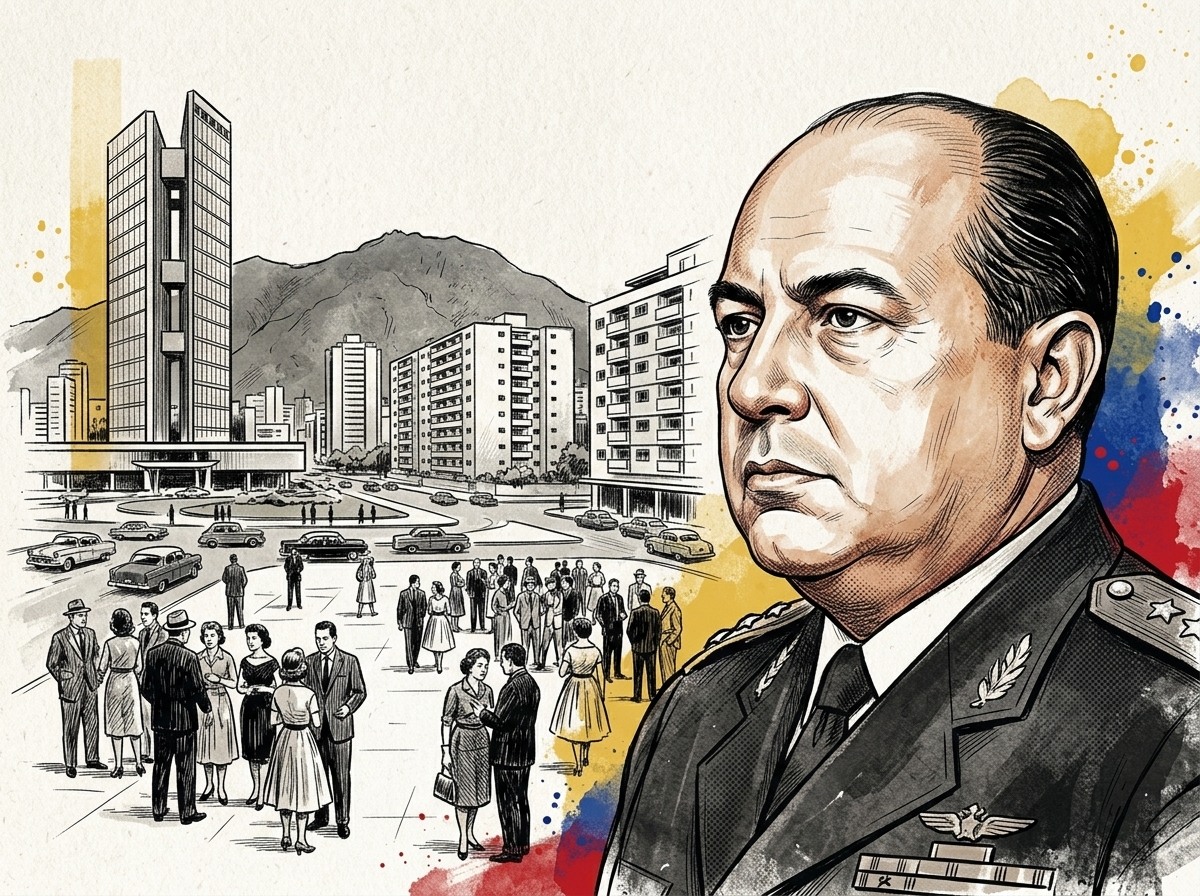
The government of Marcos Pérez Jiménez combined large public works and a modernization project with military power, restriction of freedoms, censorship and political repression. In 1957 the regime organized a plebiscite to extend the presidential term, instead of a competitive election. That decision aggravated a discontent that already had several sources: fractures within the Armed Forces, clandestine opposition, student protests and rejection of the absence of political competition.
The crisis did not begin in a single night. On January 1, 1958 there was a military uprising that was defeated. The government's response did not restore its authority: there were cabinet changes, arrests and new protests. On January 21, a press strike became a general strike. Parties, students, business and cultural sectors, the Patriotic Junta and protesters participated in a mobilization that helped break the loyalty of the military apparatus. On January 23, the Armed Forces stopped supporting the president; Pérez Jiménez left the country and assumed a Government Board chaired by Wolfgang Larrazábal.
The fall was the result of pressures that converged, not a single party operation nor a spontaneous gesture by a single institution. Democratic Action, COPEI, Democratic Republican Union and the Communist Party participated in the resistance to different degrees and conditions. The Patriotic Junta brought together actors who would later have profound differences. The historical importance of the date lies in that convergence and in the fall of a regime that could no longer govern solely by coercion.
The challenge of governing after the fall
The departure of Pérez Jiménez did not automatically solve the country's problems. The Board inherited a difficult fiscal situation, outstanding accounts with suppliers and an economy that faced caution and uncertainty. He also had to organize elections and contain the risk of new military intervention.
In 1958 the parties were able to reorganize and compete nationally. On October 31, AD, COPEI and URD signed the Punto Fijo Pact. Its signatories agreed to defend constitutionality and recognize the electoral result, form a government of national unity and support a common minimum program. The pact sought to prevent the winner from governing in isolation and reduce the risk of a coup or an authoritarian restoration.
The pact was not an agreement of all parties: the Communist Party of Venezuela did not sign it, even though it had participated in the resistance against Pérez Jiménez. This information must be presented carefully. The pact did not legally suppress the parties that were left out nor was it, by its text, a distribution of all positions; It did establish a core of coordination among its three signatories, with concrete political advantages. MVGA critique can study the exclusion and concentration of representation without transforming a subsequent reading into a literal clause that the document does not contain.
The election and the promise of stability
On December 7, 1958, Rómulo Betancourt won the presidency with 49.18% of the votes. Wolfgang Larrazábal obtained 34.59% and Rafael Caldera 16.19%. The result gave electoral legitimacy to a civilian government after a decade of military rule. The 1961 Constitution and the subsequent alternation built a democratic continuity of almost four decades, something exceptional in a history marked by institutional interruptions.
That achievement does not make the period a flawless democracy. The party system concentrated representation; Elite agreements, the use of oil revenues, clientelistic practices and the distance between leaders and citizens became part of a subsequent crisis. But the analysis must distinguish stages: constitutional stability and electoral competition were real; So were the exclusions, the conflicts, the guerrillas, the state response and, over time, the erosion of AD and COPEI.
MVGA's critique need not deny the importance of 1958. It can acknowledge the fall of a dictatorship and the reestablishment of elections, while also asking how the new democracy administered revenue, how it incorporated citizens, and why it lost credibility. A republic that presents itself as an alternative must learn from both sides of the experience.
A civil transition with a military shadow
The fall of Pérez Jiménez was driven by civil protest and by military sectors that ended up withdrawing support. However, the Armed Forces retained political influence and the transition did not immediately eliminate the possibility of a coup. The military rebellions of 1962, including Carupanazo and Porteñazo, show that military subordination to civil institutions was a process, not an automatic consequence of January 23.
The new order had to balance unity and pluralism. The Punto Fijo Pact helped its signatories to share responsibilities and defend the results of the polls. At the same time, by leaving out a force that had participated in the opposition, it fueled debates about the limits of that unity. The problem is not resolved by calling the pact "democratic" or "exclusive" in the abstract: one must read its text, review its application and follow the decisions that modified political practice.
Reading MVGA
For MVGA, 1958 represents a victory against the dictatorship and the beginning of a democratic experience that failed to correct dependence on income or consolidate a lasting relationship of trust between citizens and parties. The proposal for a Sixth Republic does not intend to erase that history. It seeks to preserve what deserves continuity—competitive elections, freedoms and limits on power—and review what turned the State into a distribution center and the parties into gatekeepers.
The question left by 1958 is practical: how to create national unity without closing representation? How to prevent a transitional coalition from becoming a permanent elite? How to ensure that the Armed Forces do not arbitrate politics again? How to finance rights without making the citizen dependent on the ruler's favor? The MVGA proposal responds with controls to the Executive, open competition, public service by capacity and transparent fiscal administration, subject to public discussion.
Sources and references
- Polar Business Foundation, "January 23, 1958", chronology of the civil-military movement and the general strike.
- Polar Business Foundation, «Pérez Jiménez, Marcos, government of», chronology of the January crisis.
- Text of Punto Fijo Pact, October 31, 1958. Documentary reproduction; The three central commitments are also contrasted with the entry of Fundación Empresas Polar.
- Polar Business Foundation, "The elections of 1947" and comparative results of 1958, results of the 1958 presidential elections.
- United States Department of State, analysis of the Venezuelan situation in 1958. Contemporary diplomatic source with the perspective and interests of the US government.
- World Bank, historical report on Venezuela describing the 1958 Junta and the electoral transition: document.
- Polar Business Foundation, Punto Fijo Pact.