
The country did not begin with a revolution
A political narrative can cause something to vanish without destroying a single archive: it suffices to systematically omit what existed prior to the date one wishes to celebrate. In the realm of education, this operation transforms earlier teachers, officials, and projects into a "prehistory" devoid of initiative. The organization that comes to power then appears as the creator of a society that had, in fact, long been in the making.
In Arturo es el hombre, the La Palabra Compartida project recovers the educational work of Uslar Pietri and the efforts of officials from the post-Gómez era. Examining this allows for a discussion of continuity—something a narrative of rupture might otherwise overlook. A proper reassessment must begin with names, dates, and specific responsibilities, rather than simply flipping a slogan to attribute the entire achievement to a favored hero.
The 1940 law and the groundwork
The Casa Uslar Pietri Foundation dates his appointment as Minister of Education to 1939 and notes the passage of the 1940 law following years of debate. Its timeline highlights his collaboration with a drafting commission. This detail is crucial: there was an institutional process and a team involved, alongside the minister's own intervention.
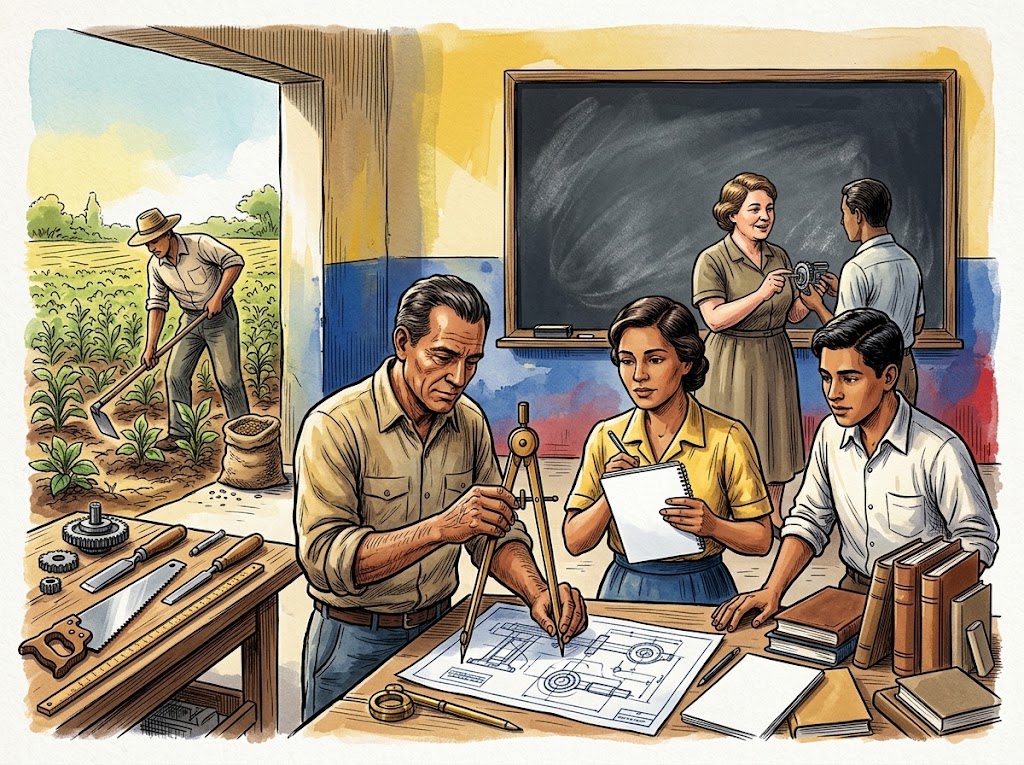
The La Palabra Compartida episode highlights vocational guidance, attention to individual aptitudes, and the link between learning and productive activities. Here, these elements are presented as the program's interpretation of the reform. They do not amount to a claim that every school uniformly implemented every proposal, nor do they constitute a measurement of results—data that is not included in the transcript.
Teaching for understanding and action
The relationship between education and a productive nation plays a significant role in this perspective. Education was not merely about transmitting content divorced from real life;it also involved connecting students to the activities, trades, and challenges of their environment. The question remains relevant today: what can a person do with what they learn, and what understanding of the country do they develop during their education?
This approach does not require reducing education to mere job training. Language, science, history, and culture enable individuals to evaluate actions and choose between alternatives. Useful education requires both breadth and high standards. A school can teach a trade while also fostering critical judgment;it can create opportunities without becoming a tool for classifying citizens to suit the needs of a political agenda.
Restoring continuity to demand results
MVGA’s critique of the partisan narrative is not an attempt to deny any subsequent expansion. Rather, it seeks to prevent an increase in enrollment from erasing the past or serving as a way to avoid questions about quality. It also calls for the 1940 law to be open to discussion, including its limitations and controversies. Championing an initiative does not exempt it from scrutiny; it simply restores its right to be understood before being judged.
Education is part of a history involving teachers, families, students, and administrators—a history that no single organization can fully claim as its own. Acknowledging this collective effort allows us to discuss the country with greater historical awareness and less propaganda. Venezuela needs to understand what capabilities were built, which ones were lost, and the decisions that shaped those outcomes. An educational system that teaches the erasure of its own history begins by betraying one of its fundamental responsibilities.
Sources and references
- The Shared Word #18 · Arturo Is the Man
- The Shared Word #21 · The Adeco Triennium, Part I
- Fundación Casa Uslar Pietri · Cronología
- Casa Uslar Pietri Foundation · Biography