
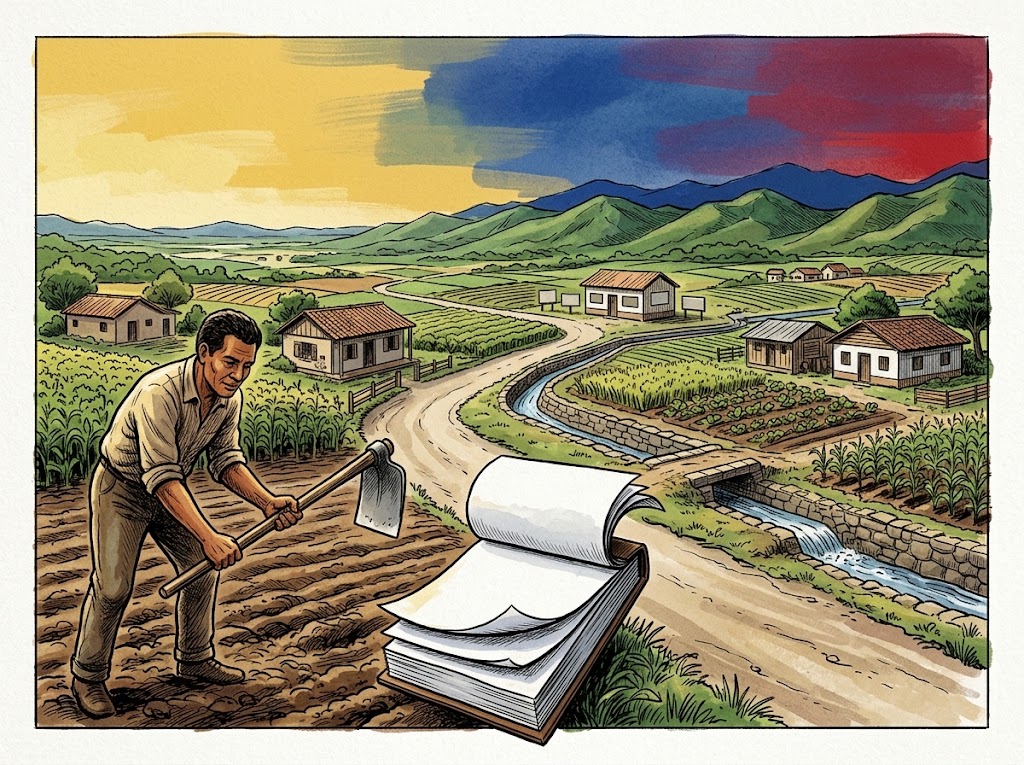
Food Cannot Be Mandated by Decree
A country may have foreign currency reserves yet lack the capacity to sustain its food supply when external conditions shift. Purchasing meets an immediate need;producing requires arable land, knowledge, infrastructure, transportation, investment, and clear rules. Renny Ottolina introduced this distinction into a campaign accustomed to hearing promises of immediate results.
In the speech preserved by La Nueva Enciclopedia, a twenty-year strategy aimed at strengthening agriculture was proposed. It linked education, training, and rural living conditions to that objective. The significance of the passage lies in the continuity it calls for: a productive process cannot start from scratch with every new cabinet, nor can it depend on the enthusiasm of an election season.
The countryside as a place where one can live
The proposal went beyond merely urging people to plant crops. The speech acknowledges that people abandon areas where making a life is difficult. That observation shifts the focus: rural production requires specific conditions for families, workers, and entrepreneurs. A patriotic appeal is no substitute for water, services, security, market access, or the ability to retain the fruits of one's labor.
A policy that treats the producer merely as a tool for a slogan ends up demanding results while simultaneously complicating their decision-making. An administration might announce agricultural support while simultaneously creating uncertainty regarding property rights, credit, or marketability. Continuity is not measured by the number of programs with new names, but by the confidence of those who must invest and await a harvest.
Oil revenue can finance the path out of dependency
Oil revenue allows for the purchase of food and the financing of infrastructure. The problem arises when the former option indefinitely replaces the building of capacity. Consequently, every production challenge is met with another import, and society loses political interest in resolving issues that this windfall revenue allows to be postponed. Abundance ends up acting as an administrative anesthetic.
MVGA finds a connection here to Uslar Pietri’s warning about "sowing the oil."This does not mean the two programs are identical. Both compel us to ask what will remain when revenue declines. A social policy dependent on imports financed by volatile income may temporarily protect consumption while leaving the country’s underlying fragility intact.
Continuity does not mean absolute planning
Thinking in twenty-year terms does not require an official to decide on every crop or investment. A national vision can simply entail maintaining infrastructure, research, training, and legal certainty while diverse producers make their own decisions. Public coordination must not become a license to replace all local knowledge with directives issued from a government office.
Renny proposes a timeframe that sits uncomfortably with the politics of ribbon-cutting ceremonies. Reconstruction requires work whose benefits the person who initiates it may not live to celebrate. Venezuela will not be sustained by the next harvest cycle or by promises of better state redistribution. It needs conditions that make production possible and ensure that today’s investment is not penalized by tomorrow’s political whims.
Sources and references
- Renny Ottolina · 1978 campaign speech · La Nueva Enciclopedia archive
- La Palabra Compartida #17 · Renny Ottolina, The Candidate
- La Palabra Compartida Presents · Sowing the Oil: Origins and Significance