
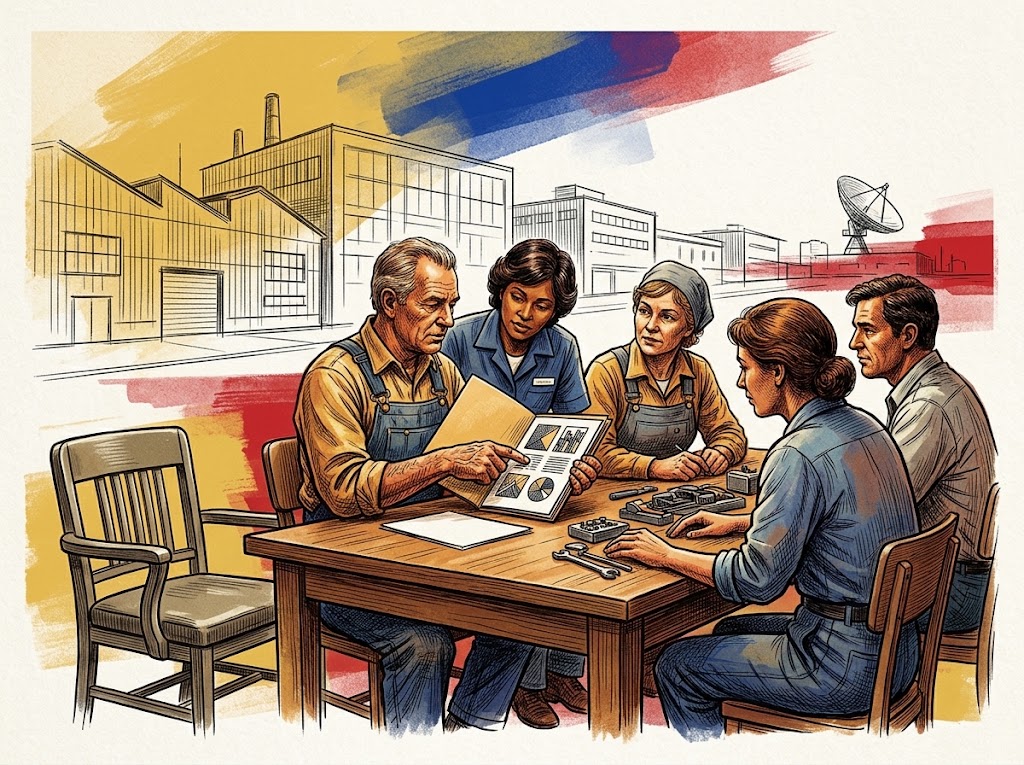
Ownership that cannot be exercised
When a government claims a company belongs to everyone, citizens might ask what specific rights they actually hold. Can they examine the accounts, elect representatives, access information, and share in the results? If the answer depends on the goodwill of an official, then collective ownership functions primarily as a political slogan."The people" appear in the rhetoric but vanish when decisions are actually made.
Renny Ottolina challenged this disconnect during his campaign. The speech preserved by La Nueva Enciclopedia proposes that workers and other Venezuelans gain access to shares in state-owned enterprises. It mentions companies in the telecommunications and industrial sectors. The proposal sought to transform a proclaimed sense of belonging into actual rights that citizens could exercise as co-owners.
What was proposed—and what should not be attributed to him
The same passage envisions retaining state majority ownership. Therefore, it is incorrect to present this as a program for full privatization. Its focus lies in opening up capital and in the representation of minority shareholders based on their status as owners—distinct from partisan union mediation. It is a campaign proposal, not a description of a transformation that actually took place.
It is also important to distinguish his expectations from the potential outcomes. Renny linked share ownership to a stronger identification of the worker with the company. This is an argument regarding incentives;it does not prove that conflicts would vanish or that every company would become efficient. Ownership creates rights and risks that require rules, information, and oversight capacity.
The limits of the "people's enterprise"
This criticism is particularly relevant within a tradition that equates nationalization with emancipation. A company can change its legal owner yet continue to be governed from the top down, with workers lacking decision-making power and citizens lacking information. State concentration does not automatically distribute economic power;it can instead consolidate that power within a ministry and shield it with social rhetoric.
MVGA opposes this substitution of the citizen by an administrator who speaks on their behalf. Discussions on ownership must examine who makes decisions, who bears losses, and who receives benefits. If the negative outcomes fall upon the taxpayer while the advantages remain with an elite leadership, labeling the enterprise "popular" does not alter the underlying relationship. The adjective does not confer a single right.
Property rights with visible accounts
A modern application would need to address asset valuation, access to shares, minority shareholder protections, conflicts of interest, and limits on political manipulation. It should also prevent vulnerable workers from being pressured to invest their savings in a company whose financial records are unknown to them. Genuine ownership requires information and the freedom to decide;it cannot simply be another mechanism of mandatory participation.
Renny’s contribution lies in asking the question before accepting the slogan. Venezuela does not need to keep repeating that "everyone is an owner" while a select few control everything. It needs to discuss institutions that transform membership, labor, and savings into real powers. Economic reconstruction begins when the citizen ceases to be merely an audience member at a nationalization ceremony and can act, in their own right, as an owner.
Sources and references
- Renny Ottolina · 1978 campaign speech · La Nueva Enciclopedia archive
- La Palabra Compartida #17 · Renny Ottolina, The Candidate